Not Identifying as Human?

The reality is that not everyone identifies as human or wants anything to do with humanism..and that’s okay. For me this is what the non-binary movement is all about. Respecting pronouns, language, and the individual.

Human is all a concept invented by who?

We are not all human, we are variables in variability. I am not an anthropologist but to me, Human is a social construct. “I” am an assemblage of experiences, with intersectional aspects of identity with other entities and “we” exists conveniently to implement an idea of togetherness. Allan Watts said..Language is a bi-product of philosophy, language is the second result. “Humanity was named Homo sapiens by Carl Linnaeus, the father of the modern system for classifying organisms, in 1758.” (PARRY 2011) Contrary to popular belief the idea that we are all homo sapiens may have been a mainstream media phenomenon brought on by Post-WW2 eugenics trauma and fear of differentiation. “Homo erectus to Modern Man: Evolution or Human Variability?” (MEILERT 1994) Meilert discusses how the controversial discoveries such as the fossils coined the ‘Peking Man’ also question the validity of linear and contemporary understandings of evolution. This isn’t a conspiracy, there is a copious amount of anthropological evidence as there is socio-anecdotal evidence to support that our character differences may be as different as our biology..not to mention how todays medical technology through HRT and CRISPR already allows us to change our genes and gene expression..on top of..the epigenetic field of science that studies how our biology in fact changes throughout our life...further removing more assumptions of the Nature Versus Nurture argument.

The queer community is constantly guilty of what Spivak would call Strategic Essentialism; categorizing sexual, gender, human/non-human identitie(s) and entitie(s) in efforts of creating communities but deteriorating social bonds between particular individuals. An alienation in unique characteristics and differentiations through normality and idealism.

On the topic of those who identity as Androphile; A person, of any gender, who loves men, or who is sexually attracted to men.

No one has the right to describe another persons behaviour or identity as gay or anything for that matter. How is it harmful that someone identifies as something that deviates from cis-herero or the subcultures of LGBTQ+? Androphile’s are just like a hand full of my friends who come from a new generation of youth that simply occupy a different space.

I’m transgender/non binary..and my partner is a cis-heterosexual male that has never had anything to do with queer culture and neither have I in many respects. It’s 2017 and what ultimately matters I think is respecting people’s pronouns, (sexual and gender) identity, behaviour, and expression based on a model of consent. Non of your arguments can be justified through assumption. The harsh reality is that 21st century understandings of language allows us to design our own micro cultures and individual existences and the people from earlier generations have a choice to adapt or resist. I don’t think We can not force community, we can only foster belonging.

Language to me has become our last resort for those that seek belonging. Audre Lordes Intersectionality allows us to see how it is possible for multiple individuals to co-exist by looking at our intersecting identity(s) and behaviour(s) create unique experiences of privilege and oppression without categorizing things as black and white, right or wrong. Queer or not queer.

Ps. After years of struggling with my gender and sexual identity, I myself see logic in words such as ambiphillia or pansexuality and know others that are ambigender and have no sexual identity. I also know individuals that use Zhe pronouns and moth pronouns..it’s 2017. James primary criticism has been towards the culture of gender expression, expression-art, design and practice. Is it appropriate to continue perpetuating a western colonial ideal in queerness and identity politics? Queer theory within itself questions legitimacy as coming out to the majority could be seen as in fact anti-queer. Recent understanding of trans studies within academia questions the binary framework of sexual orientation which may create less inclusivity than earlier historical thought. Things to think about.

I think it’s bad to practice genderism, these terms such as Androphiles were invented to be gender and sexually inclusive to those that exist outside of the gender binary. Why don’t you all just say Non-Binary don’t exist, and should all be exiled? My goodness, this thread if the definition of homonormativity.

I started @wumingbong a while ago which tag line states..THE ONLINE COMMUNITY FOR POST-HUMAN YOUTH | WE DON’T CARE IF YOU - SUBSCRIBE - BORING CONTENT QUEER CONTEXT

The youtube channel existed in order to bring together other individuals that not only identify outside the gender binary but also a community of people that don’t identify as anything. My focus for the channel has always been towards the advocacy for youth rights and giving queer and non-queer youth the platform to speak. In Canada ”Youth” is technically considered anyone between the ages of 18-30 according to many social groups in Toronto.

Honestly I don’t think it helps children to say we are all human or even call them children. Children don’t want to be viewed as children, and probably everyone that was a child would say that as well. It’s necessary for adult to recognize the positionality of children but youth are becoming so advanced and self-aware..as someone who is order, I don’t think it’s my place to define youth as anything, even human. One could argue we are marginalizing youth by defining and categorizing them as children. It makes a lot of sense to me that one day children may not identify with having parents, and today there is already evidence of that. Queer Youth Studies we learn about the difference between big C and little c and the invention of the ideal child that creates boundaries for youth and create a further intergenerational disconnect.

(This distinction between the ideal child and the figurative child *Big C, Little C* comes from Author and Queer Theorist; Lee Edelman’s book..No Future. “In this searing polemic, Lee Edelman outlines a radically uncompromising new ethics of queer theory. His main target is the all-pervasive figure of the child, which he reads as the linchpin of our universal politics of “reproductive futurism.” - Duke University)

For a more mainstream perspective of this read.. “https://medium.com/queer-theory/idolizing-the-child-means-dismissing-children-939f6ddf1fc8”
Subscribe to The Morning Email.

Wake up to the day's most important news.

Race is one thing, gender is another...but agism is eventually going to be something we need to tackle critically with the necessity of youth being apart of the conversation.

Over the years, especially after coming to terms with non-binary, transitioning..I’ve accepted that in the meantime I’m content with being read as a female, cis-woman or trans-woman and my personal pronouns being read as she/her.

My close friends and loved ones know that I prefer they/them pronouns but they also understand that I don’t identify as anything. Ultimately in this temporality and dimension..I was assigned male at birth, human at birth, child at birth BUT 2017 in a post-gender society on the brink era of transhumanism..where freedom of gender identity and expression exists..I don’t think it’s that radical to not identify with a gender or even human.

It seems to me humans (scientists and sociologist alike) have not yet even figured out what it means to be human..

So how can humans be so sure of what they are?

EDIT

Ps. Privilege is probably the biggest criticism I get when It comes to discussing gender identity and frankly it is completely justified but what most people fail to realize is that occupying spaces of privilege does not absolve an individual of marginalization and oppression. Black feminist studies such as Audre Lorde discuss..

Intersectionality: the interconnected nature of social categorizations such as race, class, and gender as they apply to a given individual or group, regarded as creating overlapping and interdependent systems of discrimination or disadvantage.

Individual or group is the key point here. I do not speak for other individuals, community(s), or group(s) that exist, but I feel I have a responsibility to speak out and encourage other transgender and gender non-conforming to speak out.

It’s important to recognize that an individual such as my self acknowledges the personhood of being (AMAB) post-transition and certain privileges that were given to me and may still be given to me are things I may still benefit from. The complicated analysis comes from medically or socially transitioning in 2017 and this practice may shift the experiences of oppression and privileges of not just me but many other trans or non-binary individuals. This shift can be traumatic and often out of our control. (For some transgender people transitioning is a practice and for others it is not but in the future I will discuss the importance of making this distinction between identity and practice, transgender and transitioning.) Writing for me as been as act of advocacy but also therapy where I can seek to discuss evidence, history, and how those intersect with personal existences. I want to also take this time to say thank you to all the supporters of @wumingbong and continue to be a part of the conversation. I hope that in time, you as reader will see that these articles are a way to find correlations between gender and transhumanism and by doing this future youth may be able to better define their own meaning of Post-Humanism.

((UPDATED DECEMBER 24TH 2017))

(This distinction between the ideal child and the figurative child *Big C, Little C* comes from Author and Queer Theorist; Lee Edelman’s book..No Future. “In this searing polemic, Lee Edelman outlines a radically uncompromising new ethics of queer theory. His main target is the all-pervasive figure of the child, which he reads as the linchpin of our universal politics of “reproductive futurism.” - Duke University)

For a more mainstream perspective of this read.. “https://medium.com/queer-theory/idolizing-the-child-means-dismissing-children-939f6ddf1fc8”
Critiquing Transgender Youtubers

There isn’t anything really appropriate with identifying myself as a critic, in fact I find it increasingly difficult to identify as anything in a post-gender society.

I’ve been making youtube videos for over a year now documenting my transition and as a form of peer-to-peer education practice. Naturally, I too can admit jumping upon the bandwagon that has now become the center of self exploitation and celebrity narcissism carefully disguised as transgender advocacy. Who ultimately has the right to speak for the entire community?

The last time I checked “the community” appeared intersectional, full of a multiplicity in sexual and gender identities. Gigi Gorgeous, Stef Sanjati, Ty Turner, to name a few have seemingly become the transgender advocates of post-gender among the growing list of sub communities on youtube (which include furries). All above the 100000th mark in subscribers..people may not be familiar with youtubers that have also sprouted who have made efforts in changing our perception of gender and may I so boldly say..ARE responsible for moving the non-binary movement forward. These people would have to include Fox & Owl, Riley J. Dennis, Chandler N Wilson, Kat Blaque, Ash Hardell, and Ashley Wylde. In a sea of; social justice warriors, antifa, right wingers, centrists, and post-humanists...all strive for a platform that supports freedom of speech crossing the line into hate speech these days seems like everyones fear.

To be critiqued.

Are you more likely to criticize someone you do know or someone you don’t know?

If you grew up in Canada or American I would imagine your answer would be don’t know (how could you hurt someone you love?), that’s because society here isn’t like a chinese confucius mentality where happiness is not defined by what the individual wants but more so what the family wants. Do what makes the family happy so that in turn will make you happy.

DONT DO WHAT MAKES YOU HAPPY?!?!

I come from a culture where constructively and sometimes not constructively criticizing your family is a sign of love, support, and a betterment for self improvement. So being born Canadian but also in a Chinese family has possibly conditioned me think of criticism as valuable and compliment as unproductive.

The war between accepting the people you love or criticizing the people you love.

Hollywoods invention and perpetuation in having #FANS and #HATER teleology...clearly that fear has turned into sweat that has leaked into assholes of queer and non-queer a like among the youtube dimension of existences.

The disappointment I have in others inability to think critically, and #takeitlightly makes me feel as if youth are being forced into particular finite states of mind. Forcing us to choose the good versus bad, to like or dislike, or a spectrum philosophy where the universe seems to me measures simply between 0-10. Of course it would be ridiculous to expect youth who are continuously stigmatized into the unknowing and ignorant to cite and reference every point they make in a youtube video in order to support their argument.

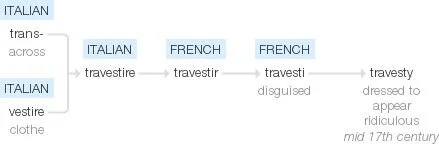
Travesty is defined today as a false representation of something but historically Travesty comes from the two Italian words Trans (meaning across) and Vestaire (meaning cloth) which make Travestire in Italian and Travestir in French. Travesti in French was used as word to describe disguised, and Travesty was a word used in 17th century to describe someone who was dressed to appear ridiculous.

Yes, the word was once used as a derogatory term for transgender individuals.

My critique is specific though, because I have to add I am not a #HATER I am simply a designer or an observer at best who looks at how passive images and clothing have influenced society. There is always value in looking at anecdotal evidence.

Anecdotal evidence is evidence based on personal account where Empirical evidence is concerned with verifiable evidence by observation rather than theory.

I’ve always said that good work is defined by good research. Understanding, predicting, and approximating the outcome before production.

Gigi Gorgeous has been quoted as saying “I can only speak from my lived experience”, which is completely valid in her expulsion but by saying that she is inadvertently advocating to youth that people are..

entitled to their opinion.

You are not entitled to your opinion, you are entitled to your informed opinion. You are allowed to talk about facts, research, and history in a way that is respectful, constructive, and critical.

Informing yourself of where ideas and identities come from can be a challenge, and forming a set of beliefs is within itself problematic. But you might be wondering why I had singled out these three youtubers in particular, and I’ll tell you why.

Genderism or Gender Binarism is the social system or cultural belief that gender is binary. Male and Female. As fashion designer I see no issues with the aesthetic value of gender binary. In fact among relationships with people I can see gender binary as a useful sociological framework that can acts as a guide for two individuals. But in a post-gender society that struggles so deeply in #pronounrespect (The act of respecting not just others gender identity and gender expression but also the pronouns that person wish’s to be called whether that is ;he/him, she/her, they/them, zhe/zer) It becomes more than troublesome for the constitution of being transgender to be primarily justified through womanhood or worst..ones ability to be read as cisgender. (To pass)

It doesn’t matter how much one advocates for transgender and non-binary rights when your approach and only bullet used is an argument is identity politics.

I think therefore I am.

Before you are misled to think one is discrediting the existences of binary identities this article’s purpose is to critique and question the approach to transgender advocacy. Shouldn’t SUPPORT be MORE than validating appearance, MORE than mindless video commentary, and MORE than number of likes/views on Youtube or Instagram?

Of course..simultaneously this is for many of us an undeniable undetectable business, as escaping the grasp from capitalism seems almost impossible at this point. Is fame still a thing?

In 2013 the Liberty Voice came out with an article by Michael Smith entitled

“Studies Show That Children Just Want to Be Famous”

“This trend towards fame was first noticed in 2007. Yalda T. Uhls did a study with Dr. Patricia Greenfield at the UCLA campus of the Children’s Digital Media Center@LA, which was published in Cyberpsychology. The study found that in 2007, “fame was the number one value communicated to preteens on popular TV.”

I was 17 in 2007...and the only thing I was doing back then? Playing video games and making youtube videos.

The years of Natalie Tran’s CommunityChannel and Charlieissocoollike...those were the good old days.

It’s almost humorous that queer culture has become a breeding ground for the most socially conscious and mature individuals that at the same time all wish to be famous for doing nothing.

I’ve discussed in other articles about how the Kardashians have never been famous for doing nothing, they really famous for selling, marketing, and advertising fashion without you ever being aware of it.

Today? People aren’t watching TV, people...being millennials and generation z...just watch youtube. If it isn’t make up tutorials its gameplay walkthroughs, if its not that it’s prank videos.

A post-gender society is also made out of non-queer and non-identity individuals that might at first appear as the cis-heteronormative but in fact are simple cisgender individuals who’s behaviour may resemble western queerness but do not associate with the queer identities.

Behaviour doesn’t constitute identity..but that’s another article.

Recently I made a comment on Stef Sanjati’s videos named Men Who Date Trans Women where she discussed her “opinion” on dating cisgender-heterosexuals.

A cis male passing individual dating a trans woman doesn’t make that male passing individual anything...because identify is based on what the individual consent’s to or identifies as and not based on any construction of binary sexual and/or gender identify. The problem is that you continue to talk about transgender issues discussing it through an identitarian political and binary lens instead of a deconstruction of gender and humanism. Also, masculine and femininity sure are signifiers to the continued stigmatization of trans/cis relationships but once you realize that sexuality is just as much a social construction as gender THEN people start to realize it doesn’t matter who you are attracted to. (Personally I think the difficulty lies more in the debate in sex versus gender and how humans constitute biology to be the root of stigmatization) Eventually you’re going to realize that your entire channel has been devoted to validating trans woman as woman instead of recognizing that intellectually NO ONE needs to maintain gender/sexual binary in order to love and be loved. Instead you could start to discuss trans and non-binary issues through assemblages (Jasmin Puar) and learn to discuss queer theory and trans studies as individual assembled experiences and not tropes. An example of this is discussing multiple gender identities that exist and how all these different identities or definitions serve different functions for the next generation. Entropy if you will. There isn’t anything wrong with you defining trans woman as woman (as I am a feminine/trans/woman passing individual) but if you continue down this road of binary tropes...you’ll soon be as outdated as the rest of the millennials.

This criticism of binary trans people on youtube is not rooted in appearance or identity...but rooted in behaviour. Advocacy. If Advocacy is defined by the “public” behaviour and support of a particular cause then doesn’t the “public” also have a right to critique the behaviour or the advocate?

The most valuable contribution that all of these youtubers whether they fall under the transgender umbrella or non-binary outskirts is Peer-To-Peer Education.

Queer Youth Studies within the Sexual Diversity Studies institution at the University Of Toronto has discussed..education as more than being understood through a conventional education at an institution.

Quoting an essay I wrote entitled “Explaining Non-Binary Pedagogy Through Queer Youth Education

(De Castell 2004) shows how there are possible reasons why queer youth may find certain ways of learning to me more ideal than others. Discussed in class Formal education emulates a particular structure and curriculum formulated for a classroom setting, Informal education are ways of passing learning through media such as television, art, and anecdotal experiences, and Non-Formal education is neither Formal or In-formal because of it’s semi-structured setting such as a community support group.

The Canadian Broadcasting Company..CBC, did a recent article called “Transgender patients face health-care discrimination, inadequate treatment” where they brought to light a very common issue within Canada’s Health Care System where doctors and nurses and front line workers have not been trained properly in order to serve and treat transgender and non binary patients appropriately. This explains exactly the phenomenon, function and importance of the transgender and non-binary youtube community seeking knowledge from each other directly in matters of Hormone Replacement Therapy.

But when health and transitioning education leaks into celebrity and fashion culture the distortion becomes not just confusing but embarrassing. This embarrassment becomes a cloud that creates false attitudes, biased information, and extremist behaviour that rains what I would call a false representation of transgender and non-binary AND binary individuals.

This false representation is a travesty, and I see a post-gender future where criticism is more than welcomed, it is encouraged in order to improve the well being of ourselves and our ignorances.

Travesty as defined as false representation makes us question whether it is even possible for a transgender or non-binary advocate to exist; as representation implies acting on the behalf of others. Therefore, this oxymoron could be the invisible resentment we have towards the act of publicly, superficially, or functionally transitioning on youtube while at the same time seeing value in the showing others true representation.

What is authentic Peer-To-Peer Education? What is authenticity?

How do you design VALUE?

My bio-father always said...my greatest challenge is teaching to you to understand the value of the dollar. What is the value of money? A definition of pro-capitalism debate aside...fashion and gender expression has always been a part of my life but my continued struggle is questioning the value of not the dollar...but the value of fashion design. How do you measure creativity and/or credibility?

I came across this article by The Business Of Fashion entitled The Psychology Of The Designer Bag

I found this article so interesting because it questions why people purchase designer bags and as myself an avid collector and seller of them..makes me question how the bags such as the Chanel 2.55 and Hermes Birkin designed over a 100 years ago have created a brand new economics and social construction which continues to motivate and influence cis-woman of the fashion industry. What does this mean for gender and future genders? Binary and Non-Binary Gender? What do we value, will value, and continue to value?

As this article basically makes the case that the only real function of a designer bag..is to make you feel good, regardless of it’s utility.

Make you feel good. Makes me think whether or not my love for fashion is rooted in misery and depression but that’s another story.

When we think about designer bags, often what comes to mind is it’s value. What makes a designer bag valuable, and how did designer bags become economically valuable? A couple years ago I watched a documentary called Cutie and the Boxer which documented an older artist named Ushio Shinohara and their continued struggle to sell art, making money, and survive as an artist in the 21’st century residing in New York City. There is a scene from the movie where a curator and collector visit Shinohara’s studio looking to purchase a piece of work for the MOMA. Museum of Modern Art. I vividly remember that the rep from MOMA was requesting to see one of his earlier works that was significant to a particular time period of art in New York City. The boxer paintings. In that moment I hard realized this may be the secret to the value of art and possibly design. The value of the art would maybe be not rooted in the quality, in the context, in the function, or even the quantity...but actually rooted in it’s historical and cultural significance of the time period it was produced.

Most people wouldn’t know that the Vuitton family of Louis Vuitton invented stackable luggage in 1854, or Thomas Burberry was actually an engineer for the British government in 1856 inventing waterproof fabric for the military patenting it with the famous tartan or Coco Chanel designing the first hand bag with a chain in the 1920’s minimizing the idea of femininity at time period of plumes and feathers.

Year 2012..were monumental years for myself as a fashion designer because it was at a time in my career where I did not understand the reasoning for particular moments of media success. For the longest time I have never understood why people found value in the dresses I was making or the fashion shows I was producing. My work had not been particularly made well, or made with expensive fabrics but when Gawker and the New York Observer had written about my second show where I had used the V for Vendetta masks on the models, it all made sense to me.

The collection I had done was entitled..

“FALL/WINTER 2012 entitled Hierarchy Of Needs” Here is a statement made on the collection and my rationale for producing the show.

The collection had been planned to appear as a normal fashion show set in the south of France with balloon trees and pluming, draped frocks, but at the last second Adrienne had the models faces covered with Vendetta Masks. This was a clear reference to Occupy Wall Street that had been happening at the time where protesters were living in on the streets of Wall Street protesting the corruption of capitalism. The show garnered the most mainstream media coverage to date where the New York Observer and Gawker Media both had questioned the use of masks in the show. It is always a challenge for a fashion designer to research and design originality but our ability to recognize our privilege to design and produce commentary is much more challenging. How do we change the system in order to improve the lives of people who also have disabilities, people of colour, transgender and non binary youth? Change our priorities. This collection was a perfect example of shifting our attention using graphic and fashion design in order to beginning the process of questioning the existence of fashion and what it has become in the 2010’s. Giving the commentary to someone else instead of speaking for them. Adrienne’s over goal is still yet to be achieved which is; shifting the commentary of gender...how do we use fashion and fashion theory as a tool for producing gender equality and pronoun respect? Fashion will continue to exist but style is dead, trends are dead, our responsibly NOW as fashion designers “should be” to help the INDIVIDUAL transition and become their own trope, their own individual.

Going back to my “How-To-Invent-Value-Realization” it had also occurred to me from years of research that this has happened many times in history. Most people wouldn’t know that the engagement ring didn’t exist until the 1930’s and you can read this article by entitled “How Ad Campaign Invented the Diamond Engagement Ring” by the Atlantic to learn more about it. Spoiler alert..you probably won’t be happy to hear that it was the mining companies that started the engagement ring craze that still exist today. De Beers basically invented the value of diamonds. To take this further, it is crazy to me that Hollywood and the invention of movies and feature films have also made an impact on the value of products...cough cough..Breakfast at Tiffany’s.

Fast forward to 2017 I recently came across this article on Kendall Jenner who was ‘Fashion Icon Of The Decade’..and frankly it makes a lot of sense to me.

I think it’s difficult for others to admit when they are being influenced, and that’s including myself. What I have inherently learned from fashion is that things (products, people, campaigns) that succeed are typically tacit.

Implied without being stated. It makes a lot of sense to me why Kendall Jenner was declared style icon of the decade. If our society still defines beauty based on a colonial and roman standard..the Kardashians have undoubtably made an impact on society, THOUGH it doesn’t make it right...they do impact especially how one presents themselves today.

Looking at the cultural and future significance of Kanye West’s line is an entirely different conversation..but it is clear the infamous family has influenced each other as a whole. I find similarities in Luca Fersko and Kendall because of their {gender binary) youth appeal but also both’s effortlessness in appearance. There is a relate-ability with both of them, in a culture that now strives for simplicity, sexiness, and beauty based upon the constitution of youthfulness. Excusing the unrealistic body standards that the fashion industry continually perpetuates on to youth and society, there is to me still aesthetic value. Kendall Jenner 2010’s approach to appearance is to me not comparable to the decades of 1900’s to 2000’s as there is a removal of tropes, and a focus on function within a 21st century perspective.

Honestly I continue to marvel at how Kendall and her team of stylists, influencers, and business create value. The invention of value, and the invisible traits of the Kardashians being individual fashion designers. When the speedy has been defined as the most iconic bag designed by Louis Vuitton besides it’s creation of the LV luggage trunks..it’s fascinating to me that Kendall Jenner is modernized a top handle bag in 2017 typically considered a style of bag for the older cis-woman.

Just like how we look at an artist or designer’s life as much as their work, by making that distinction we are able to analyze how generations evolve, but also how economics evolves.

If you’re interested you should read this article called “Forget logos and bling: the new status bags are strictly below the radar” by the UK TIMES. It’s really interesting because in predicting the nature of a fashion economics or culture economics..comparing the actions of Kendall Jenner and this new mentality of the no logo bag may possibly provokes us to wonder what do we ultimately value as a society.

As for me? Designing a product isn’t enough anymore, you also have to design a culture, a lifestyle, a trope, ideas that encompass that product.

Going from inventing a new product to designing value, designing cultural and historical significance to go along with that product..is probably more work than I asked for.

Could you let me know when capitalism isn’t a thing anymore? Thanks.

Ps. How do you design or make something that is timeless? F****************CK

..is #PANPOLY a dilemma?

Side note: The purpose of this article is not to express my personal experience with pansexuality but to look at the correlations, economics, and current mainstream ideas of pansexual, panromantic, and polyamorous related ideas. Of course I could mention my experiences with specific genders and make generalized statements of how I think binary stereotypes have effected my platonic, romantic, and sexual experiences but I find it more interesting how #PANPOLY is composed of multiple movements, concepts, and ideas that over lap historically which question and deconstruct the value of social roles in human relations.

Surprisingly I’m coming to think that the most underrated difficulty in sexual and romance culture are how social roles are projected unto us, instead of looking at each other as individuals. I don’t blame anyone, but we do already live in homonormative society according to Professor of Social and Cultural Analysis at New York University, Lisa Duggan.

HOMONORMATIVITY: “A politics that does not contest dominant heteronormative assumptions and institutions, but upholds and sustains them, while promising the possibility of a demobilized gay constituency and a privatized, depoliticized gay culture anchored in domesticity and consumption” (Duggan 2003)

The issue is that cis-gay culture is still affected by heteronormative assumptions brought on my historical traditions and practices. Personally I find it difficult to exist as non-binary in a society that is inherently still binary, not just in gender but in sexuality. Possibly LGBTQ+ and Queerness have become mainstream symbols for sexual minorities but the continued disconnect are trans studies distinction between sexuality and gender. Without making this distinction essentialism can become a symptom of the people. I don’t often refer to romance culture as dating culture, but if you knew me and my writing I have my own difficulties with the concept of dating. Romance on the other day portrays an angle more specific and unique to particular moments. Being a romantic obviously stems from expression of love but engaging in sexual and emotional acts in a post-gender society still breeds assumptions and actions that are performed after conversations of consent are held...provoke and question the value of romanticism as a whole, as a concept.

From the act of sex to the act of romance.

Romanticism has been typically defined as a movement and more specifically movement emphasizing “..inspiration, subjectivity, and the primacy of the individual.” according to Apple’s Dictionary.

Primacy. The fact of being more important. Which almost goes entirely against my previous conversation on polyamory. Does monogamy even exist in a polyamorous society? If we can embrace, race, gender and sexual diversity why are we technically behind on romance diversity?

My experiences of romantic interaction has been wildly different throughout my life, to the intergeneration to gender differences with each new interaction you would think force us to rethink our assumptions when approaching individuals of romantic interest.

It is impossible for me to discredit those who have come before us, those who have been gay identified a part of the gay community...have at the same time marginalized trans and non-binary people within the community. Toronto in particular has now sprouted a chaos and entropy; pockets of communities not just in a racial minories, but gender and sexual minorities. And to be honest, it is becoming increasingly difficult to associate myself with a gay community that in still built on a fundamentally binary framework.

The word itself, Gay...imply’s a binary of opposite sexs...and historically was invented by the medical institution has signifiers of sexual “deviance” of the time.

Of the time. Historically, it makes complete sense that these communities are still thriving and necessary but to use homo normative language such as “top” and “bottom” already places ridiculous assumptions of social roles on a gender and neuro divergent, spectral, temporal society. These assumptions can be damaging and confusing to individuals that don’t even view their body as feminine or masculine, giving and receiving, etc.

Unfortunately, in many ways our physicality’s have socially dictated our ‘social role assumptions’ and not projecting the sexual and romantic assumptions can be a challenge when we are also faced with the chemical and hormonal reactions that happen in our body when meeting someone we like, have been with, or just do not know.

Even how we define knowing someone, the amount of time needed to know someone, or the amount of knowledge or value of knowledge that has been exchanged in order to “know” another individual.

I think it’s normal for us to have and question an idea of who we should be friends with, the people we should be associating ourselves with, the person you should kiss, hug, hold your hand, have sex or a life with. To have an idea allows us a visualization of framework, a map if you will that allows us to have an idea of what will happen in the future. OUR existential ability in free will to choose what will happen may give us comfort and stability. Makes sense right? You can’t have other people make those decisions for you, because it’s you. But isn’t...to have an idea of what you want then meeting someone..automatically create a projection of wants and needs unto that individual? What does it mean to know someone for who they are and not what you want them to be? Femme, Masc, Neutral, Sane, Insane, Small, Large, Young, Middle Aged, Old...etc.

In a society that is slowing coming to terms with their own polyamorous and panromantic/sexual tendencies it may be difficult to balance, make sense, or even articulate what our minds seek to understand further versus what our bodies desire with at the same time looking at how we ourselves are positioned in relation to the individual you are attracted to. Without a degree of (idea invention) essentialism and articulation...uncertainty becomes a source of anxiety within PANPOLY connections.

Strategic Essentialism is a word used in Queer Theory to describe how labels and definitions still offer a valuable action in laying out a basic framework for an individual and create shared communities. The act of identifying.

But in an age of pansexual and polyamorous understanding of society, the act of practice becomes the labour.

The Hinduism have said that worrying about the past is depression and worrying about the future is anxiety...and personally I remember a time where it was almost impossible to function because one was exist on either ends of the spectrum. To live in the live in the moment is within itself a practice? Practicing mindfulness. Practicing Pronoun Respect. Practicing Art. Practicing Sex. Practicing Romance.

But Quare Theory, by Patrick Johnson a leader in Queer Of Colour Critique discusses the distinctions between Theory Versus Praxis. The requirements for certain individuals to actively empathic and dissect the lived experiences of everyday people instead of inventing new theoretical understanding. It is always a challenge to remove yourself from what you understand someones identity to be and look directly at ones individual experiences and practice.

“Quare” studies, or (almost) everything I know about queer studies I learned from my grandmother. E. Patrick Johnson

A literal practice in design and problem solving. Designing your own terms, rules, within connections instead of following the frame work of binary social roles.

There is even issues with the idea of spectrum because the spectrum theory itself creates a binary of one end to the other...why might someone have difficulty leaving the spectrum, the binary?

Control. I mean loosing control of your emotions, your body, your life has been bread into our psyche as a bad thing. Almost the definition of insanity. I learned from someone who has schizoaffective affective that sanity and institutional bias creates streams of normality that further stigmatize the neurodivergent and those members of disability studies. The social construction of mental illness and the subjectivity of individual health or informed consent. Social roles allow us a framework that allows for easy control of ourselves and others. Lets face it. Ignorance is brought on by assumption as they say. And only way to inform yourself is to ask questions, and at the same time not assuming that asking questions invents a motive. One could even argue we still live in a society that stigmatizes asking questions as abrasive, unnatural, and aggressive.

Which is fascinating when someone like Dr Brené Brown who studies human connection and humans ability to empathize, belong, and love discovered that in a study the differences between who have the most sense of worthiness, strong sense of love and belonging and those who struggle for worthiness who are always wondering if they are good enough.

“..and to me, the hard part of the one thing that keeps us out of connection is our fear that we are not worthy of connection.” - Dr Brene Brown

They had found that the commonalities who felt worthiness were the people who were able to be vulnerable, and individuals who are able to fully embrace vulnerability. They had courage to be imperfect, compassion for themselves. Talking about vulnerability as not comfortable but it being necessary. The willingness to invest in a relationship that may or may not work out. The willingness to say I love you first. And in my subjective opinion, I think these should be traits and attributes of polyamorous and panromantic/sexual individuals. As social scientists, art historians/critiques/curators, queer theorists, and trans studies researchers..our job is to control, predict, and archive. This contradiction, can be confusing in a conversation about love, and the articulation of feelings. Emotional Literacy.

“Here’s the thing, I’m struggling. Well I have a vulnerability issue and I know vulnerability is the core of shame and fear and our struggle for worthiness but it appears that it’s also the birthplace of joy, of creativity, of belonging, of love. And I think I have a problem, and I just need some help. ” - Dr Brene Brown

The link to Dr Brene Brown’s Lecture; https://www.youtube.com/watch?v=iCvmsMzlF7o

Your struggle may not be an absence of what you want but a struggle to accept yourself for being accepting in a society that is built on categories.. if you relate with pansexuality. By accepting and seeing beauty in the diverse instead of particular tropes, you yourself can become stigmatized as the whore, deviant, or sex addict. Projecting past experiences on to current prospects, friends, or colleagues. And then again there are people who identify with fetishism, and embrace the position sexual promiscuity..not to mention those who are sex workers and embrace that practice. Contradiction once again.

Google defines pansexuality as; not limited in sexual choice with regard to biological sex, gender, or gender identity....but when if you don’t inhabit any of these identities or boxes? Pan-romantic has also been an idea embraced by the queer and non-queer community. But what does any of this have to do with control?

In a culture still defining love and romance as monogamy, how do gender variant or non-binary individuals navigate in a world that projects a sexual binary on to individuals but still placing expectations of “I love you for you” romance if both binary biases are still at play? Sexual and romantic binary. Do we then need a new definition of romanticism or does this already point out the distinction and/or contradictions between romance and intimacy?

If romance and the concept itself is quintessentially problematic under a non-binary framework, than are there only intimate acts? Non-Binary defined as not only those who do not identify as male or female but also those that do not inhabit a space of identity. Furthermore, one would view Non-Binary as space where contradiction is embraced. Embraced under not a frame work of social roles but consent and engagement.

Google defines intimacy as; a close familiarity or friendship; closeness as well as the intimate act of sexual intercourse. Which brings to light the contractions between romancism and and intimacy.

As it may be common to interchange the two..does friendship then even exist in a #PANPOLY society? If all feelings, thoughts, and acts between individuals are defined as complimentary actions that do not inhabit a permanent subject position. Transient thinking. Non-Linear Progression.

Ignorance in queer theory is not just defined as an unknowing of knowledge but also an unlearning of knowledge in order to learn new knowledge. Temporal knowledge of future generations to come and when what we may see are over laps in understanding and misunderstanding that prevent us from living our full potential.

So what is my social role, what is the dilemma? The dilemma is that myself who practices and understands pansexuality and polyamory am confronted with a constant implication of binary romance, sexuality, and gender that effects my ability to be understood. My role is to engage within a society that fears consistent engagement as an assumption of agreeance and commitment, when engagement is actually unambiguous of any framework. Intimate or platonic engagement may often be mistaken for romantic or sexual intention and the implication of any #PANPOLY interaction may require the articulation of emotional literacy and as discussed earlier our ability to embrace contradiction.

Wiki: The term was first used by Claude Steiner (1997) who says:

Emotional literacy is made up of ‘the ability to understand your emotions, the ability to listen to others and empathize with their emotions, and the ability to express emotions productively. To be emotionally literate is to be able to handle emotions in a way that improves your personal power and improves the quality of life around you. Emotional literacy improves relationships, creates loving possibilities between people, makes co-operative work possible, and facilitates the feeling of community.

Before I end this post I also want to include a few chunks from Berkeley University’s article which points out ones ability to avoid what they define as THE “FOUR HORSEMEN” IN RELATIONSHIPS.

1. Criticism. Some forms of criticism are constructive, but in this case criticism refers to making negative judgments or proclamations about your partner in extreme, absolute terms. A sign that you may be engaging in this more harmful form of criticism is if you catch yourself using terms like “never” and always”—for example, “You never think about anyone but yourself!” or, “You are always so stubborn!”

2. Contempt. Contempt is a more destructive form of criticism that involves treating your partner with disrespect, disgust, condescension, or ridicule. It may involve mean-spirited sarcasm, mockery, eye-rolling, sneering, or name-calling. Contempt can grow over time when a person focuses on the qualities they dislike in their partner and builds up these qualities in their mind.

3. Defensiveness. Defensiveness tends to arise when people feel criticized or attacked; it involves making excuses to avoid taking responsibility, or even deflecting blame onto your partner. If you hear yourself saying “I didn’t do anything wrong,” or blaming your partner for something else after he or she has leveled a complaint against you, ask yourself whether this is really the case. Even if your partner made some mistakes, that doesn’t free you from responsibility for things you could have done differently as well. The problem with defensiveness is that it communicates to your partner that you aren’t really listening to her or taking his concerns seriously. And by introducing new grievances, it can also exacerbate the conflict by making your partner feel attacked and defensive.

4. Stonewalling. Stonewalling involves putting up a (metaphorical) wall between you and your partner by withdrawing, shutting down, and physically and emotionally distancing yourself from your partner. An example of stonewalling is to give your partner the “silent treatment” or to abruptly leave without telling your partner where you’re going. Stonewalling can sometimes result when the first three “horsemen” accumulate and become overwhelming. Stonewalling is especially destructive to relationships because it can make one’s partner feel abandoned and rejected.

But you can see the link to the original article here...http://ggia.berkeley.edu/practice/avoiding_the_four_horsemen_in_relationships

And I think the only realization I am having after writing this article is that even though I may have let go of control, jealousy, and possession years ago, relieving the fear of uncertainty and learning to embrace negotiation between individuals regardless of experiencing rejection still lingers as anxiety.

Furthermore, what I understand to be appropriate streams of thought may simply be subjective, inconclusive, and also explain others misunderstanding of my particular subject position.

Why has understanding and contradiction been interpreted as mutually exclusive?

May the articles written be an excessive interest in ones self or an archival diary of emotional literacy misunderstood by beings that still identify as human.

“You know how there are people that like when they realize that vulnerability and tenderness is important, that they surrender and walk into it? A: That’s not me B: I don’t even hang out with people like that.” - Dr Brene Brown

“You cannot selectively numb emotion. When you numb those, we numb joy and gratitude, we numb happiness. And then we are miserable, and we are looking for purpose and meaning, and then we feel vulnerable so then we have a couple of beers and a banana nut muffin.” - Dr Brene Brown

Post-Human Relationship 101

So it’s been a while since I’ve written an opinion piece on here. 

A quick update would include being on Hormone Replacement Therapy for about a year and a half, establishing a small group of artist/critic friends who all happen to be transgender and (trans) friendly, and University Of Toronto kicking me out for my marks being too low. 

Career wise, I started fashion designing again and was recently invited on an all expense paid trip to Festival Mode Design in Montreal. We were on a delegation from Toronto of significant people who started the Canadian Fashion Industry, (some who also happened to be one of my mentors over the years such as Robin Kay and Jeanne Beker). A little awkward because it was my first appearance among colleges post-transition. When I say we, I also mean my boyfriend attending the trip as well. 

Boyfriend right? Shocker. Non-Binary/Trans genderless alien dating a cis-hetero and male passing individual. See…I grew my hair out and now a days I’m less E.T and more Memoirs of A Geisha. Simple chinese makeup, black bob, 5’5, booty and perky tits. The thing about us is that we don’t actually gender each other very often. Even though I don’t mind she/her pronouns, we both pretty much always use they/them with each other. 

Ultimately we’ve moved past the identitarian politics. For me and a lot of friends of mine…after you understand gender (or gender binary) isn’t really a thing, neither is sexual identity. Basically for me, my partner, and the rest of my friends we don’t care who you’re attracted to, or who you have sex with..we get that your behaviour doesn’t define your identity, or the self..let alone your genitals don’t dictate your gender. Furthermore, who needs to label anything if you understand the foundations of pansexuality to polyamory? Before you right us off as hippy’s…trans humanist ideas such as Morphological Freedom support “queerness” distinction from “transition”. Transgender versus Transition. And medically transitioning for me, is very much a practice rather than an identity. 

We met in an art gallery. I opened during the summer of July an art gallery called Chinatown Gallery at spadina and queen, to help a bunch of my trans and non-binary artist friends sell and promote work. No one bought anything. But it was a great learning experience also because Will Carpenter’s paintings were hung in the gallery and by chance Matthew was friends with him. Matt walked into the gallery and I was just cleaning, our eyes met and bing bang boom…we chatted, shared work and information. A couple days later we had an opening party and after everyone left…lets just say clothes came off, right there. That night Matthew told me something funny…”I didn’t know you were trans..”…”..I know the situation I’m in, I can continue living my life comfortably or just cross this line of social construction”. I’m paraphrasing. It was clear that Matthew has already been immersed in an Toronto art culture with multiple friends who were trans or nonbinary or both. BUT it was also clear that Matthew has never really been a part of queer culture. Historically only being with cis-woman. Regardless…I was immediately drawn to Matthew’s unfiltered critiques of sanity and countless conversations on the objectivities of human experience. Matthew is less an artist and more an Art Historian or Critique. 

After that night Matthew read me a poem they wrote for me. 

the form, void and water 

the fist things described 

in genesis 

I search for land across the 

lake from you gucci gucci

palace in the west above 

I search for morning racing to

get lost a long drive from home 

but we caught a shipping wind 

sailing my mess organized from 

blood in three quarter time 

love is lonely loose and a stroke 

off good luck fa choy

far from a trouble you bought

me micky dees 

-Matthew Grimm

25 years of dating/relationships/connection no one had ever written me a poem. It was a lot. They were everything I ever wanted in a person. 

I will always remember the first time Matthew said…”I love you maybe?”. I was about to leave Matt’s apartment and as I reached to close the door I heard those words. I walked back and leaned on the side of the door and said “I’ll see you tomorrow, smiled, and left”. The next day, I wrote this love letter. 

Dear Matthew, I only grew my hair out so that I would co-exist with the first human that wanted to be with me. You are right about somethings and wrong about others. You are right about sanity. Sanity can be as much a choice as love. There is even a problem with “I” in this letter because I don’t believe the self exist. Love is simply a choice to keep engaging as much as it is to live is to keep existing or making the choice to end ones experience of existence. The reason romance plays a function is because I make a distinction between love and romance. What you are wrong about is education. The internet is education, an extension of the consciousness and many will live and die never applying the knowledge they have input. Also, Matthew you should know, I never gender you when I am away from you. This is because gender is the matrix. We have the ability to design our sanity, our existence. I’ve been one for long enough, work as a singular and if you’re looking to choose an extended reality with me, I love you too. Ps. I’ll have sex with you eventually. — adr 胡明邦

Without going into specifics, we have both approximated that I don’t believe that identity exists and for them reality doesn’t really exists. What does this mean for humanism? I think this is just the beginning of research that goes beyond social science and applied science. When I think about the new(er) fields of study such as cognitive science and psycho analysis which blends the social and the applied…taking into account entities and AI (Artificial Intelligence) within humanism (..to seek solely rational ways of solving human problems), I think about the ever changing meanings of relationships. 

Cognitive Biases, Hormonal Biases, or even Sanity Biases that prevent human from being fully rational give evidence to a post-human society. 

My argument, continued argument is that no matter how many scientific achievements we make that change our genetics (such as Hormone Replacement Therapy or cognitive technologies such as Anti-Psychotics) and change what it means to be human…shouldn’t romance or romanticism still play a function in society?

But maybe I’m wrong, this whole article is simply anecdotal evidence..

AND I’ll get back to you on Matthew and I…

..my RELATIONSHIP with polyamory.

Approaching my thirties, it’s easy to reminisce on the physical things that have happened until now..you know those birthday parties at your parents house, your first pay check or mortgage application, bullies in high school to friends that you don’t speak to anymore. Events, moments, and people themselves that defined milestones in the realization that you exist as a singular in this world.

Me? Growing up with an extremely privilege upbringing...the physical stuff...didn’t really cut it. Sometimes, it doesn’t feel like anything. Reminiscing the physical stuff..the things you earned, you made, you built...that served a function. Work can be anything, work can be the things we do or the things we create to fulfill some kind of purpose or function in order to make a living and make difference in this world.

The only shit I seem to reminisce about are the specific feelings, thoughts, and learnings of the connections I’ve made until now. #Deadlife and #Newlife post transition. The only shit that seems to matters to me. I’m so tired of reading these psychology studies on my facebook feed discussing how only sociopaths and narcissists stay in touch with their ex’s when I take pride in the things I write about. Don’t get me wrong I can have narcissistic tendencies and I see can value in sociopathic behaviour. If you’ve ever read anything I’ve done, you’d know I do value in expressing personal aspects of my life, anecdotal (and empirical) evidence, and this constant question of authenticity. Transparency.

For as long as I can remember, I’ve never believed love ends. It didn’t make sense to me that if two people stopped talking, used the words on a “break” meant you didn’t love each other anymore. For me it has always been a continuum, a point on a graph that keeps on going until a new point raises above the rest and by the end your life is just a collection of points. Not a collection of memories or moments but literal people with individual lives that came into yours and altered it. These people have individual minds, and bodies, and their own universe and perception of reality, families, hardships and pleasures that define their being.

But I hadn’t realized that love possibly never begins until after I transitioned, until after I realized I was non-binary. This is because after you realize that what you are attracted to shouldn’t really matter, what you identify as your gender shouldn’t really matter than...why should it matter who you love, how many you love...why should it matter if it ends. What does it mean to have commitments or responsibilities with someone?

This is where you might be scratching your head.

WHY SHOULD IT MATTER IF IT ENDS? WHY SHOULD IT MATTER IF MY RELATIONSHIP WILL END? This person is my everything, this person is my partner, this person loves me no matter what, this person and I have a family, what are you talking about?

Well it doesn’t. Because it’s just a choice isn’t it? A choice you made to keep engaging. Isn’t that just what love is? Love is more than words, it’s action. But very few people you know you want to be in action with all the time, let you see them naked, touch you for a couple hours, hold hands in public, have joint checking accounts with..

In every way, it makes sense to me that things FEEL as if they are ended but the moment you engage AGAIN...isn’t that un-ending it? Ya’ll know what I’m talking about...things don’t work about and then one day...maybe it’s a week, a month, a year...you get that DM...that text that says...

hey. how are you?

or worst..

I miss you.

Regardless of who ended it. I never have never thought one person has the ability to end a “relationship”. I think all connections or “relationships” are a two way street. One person can end it but the other party can fight for them, work it out, talk it out, and communicate what brought them to this point in the first place. Not to mention timing has a lot to do with whether someone is even in the mind set to date, or have “relationship”, a family, build a life together.

One of the biggest things I learned being attracted to, flirting with, and dating women or AFAB’S (Assigned Female At Birth) or those with female experience is that love is a negotiation...where individuals with testosterone who do have a higher sex drive may see love as more of a finite or a physical decision.

As someone who has had male privilege, but has struggling with gender their entire life...it’s been difficult navigating the logic and feelings that come with loving someone. Loving someone as an act and not an identity. I love you as verb and not a subject position.

Come on, so you meet someone on the street...you find each other attractive because you ask them out on a date and they say yes...you’re dating? In a “relationship”? Just like that? How is that possible? You don’t know each other.

After my longest “relationship” slowly stopped engaging with me I had realized...I never really wanted to feel love...I wanted to be understood. I rather feel understood than to feel adored, or admired because the act of understanding is within itself an act of love. People ask me, than what is understanding?

Understanding is asking question with someone and experiencing things with someone. For a long time, I thought if someone isn’t asking question they probably don’t really like me. I still struggle with this. I mean if you are telling me you have feelings for me without asking me questions...aren’t you just falling for my body? Well no...I think you can learn a lot about someone through the physical interactions. Not just the physical interactions of family life, but also the physical practices they endure on a daily basis such as writing, drawing, biking, eating, etc.

There are things that are unique to an individual transitioning and these things have nothing to do with transgender politics. These things have to do with binding, and tucking, and things trans people do on a daily basis in order for them to alleviate gender or body dysphoria. Transitioning can be considered a practice that not all transgender individuals endure but are things we do to make other people treat us differently, gender us differently. To not be misgendered. Ultimately the things we do that make others attracted to us and the fear of not ruining how others are perceiving our gender or attractiveness. For me that is truly stressful.

One could say, sex for some is more of a physical pleasurable act and for others it is a more of an emotional act. But what happens when you lack the emotional literacy to express or even be aware of what you and your mind actually want and how your body responds to the things you want.

This is a struggle.

If language is needed to help us identify who we are but also the issue...the fundamental problem of how “relationships” literally end and begin...how doesn’t temporality play a major factor in long lasting connections?

According to Wiki..”Polyamory (from Greek πολύ poly, “many, several”, and Latin amor, “love”) is the practice of or desire for intimate “relationships” with more than one partner, with the knowledge of all partners.[1][2] It has been described as “consensual, ethical, and responsible non-monogamy”.”

Knowledge transparency has taught me how to be live authentically, in order for others to understand who I really am. The only way I can do that is to be honest about what I am thinking and feeling at any time and communicate it in a way that doesn’t imply anyone is at fault. But of course this is challenging for anyone to actually practices because my capitalist business side comes out and quotes Bob Proctor “Accountability: The glue that ties commitment to results”.

If someones feelings are hurt whether you know them very well or not, I’ve always felt is always appropriate to acknowledge, validate, and be accountable to that persons feelings and/or subject position. Why? Because I can never assume my experiences are the same as others. This is also a practice in empathy not sympathy.

Dr. Brene Brown would say “Rarely does a response make something better, what makes something better is connection”.

So what does all of this have to do with dating? Well..I’ve come to understand that...even if a “relationship” ends for a day, a week, a year...the minute you connect again...THAT...is progress.

Progress and transient thinking has been a focus in my writing for many months now because I’ve come to admire theorist such as Deleuze and Guattari. A Thousand Plateaus: Capitalism and Schizophrenia is a 1980 philosophy book who talks about Non-Linear Progression.

And when Dan Savage says...“Why isn’t making the sacrifice to be monogamous considered to be nobler than this myth of effortless monogamy that’s a result of love and passion?”

This sacrifice that (to me) is really the emotional and physical labour that goes into continuing engagement and negotiation with someone you find deeply attractive and understanding..REGARDLESS if you see or don’t see a future with this person.

This sacrifice is the choice we make everyday to keep engaging with people we love..REGARDLESS of whether you are fucking or not fucking this person.

I’m not one to discuss divorce or marriage because those are not or not yet my experiences but even a conversation between Sidra and Ben who have been married for 11 years on the youtube channel ‘The Skin Deep’ discuss how love for them is simply the choice they make every single day to keep love each other..regardless of the children they have together.

I have a really hard time dealing-with connection now because I am able to view it through this non-linear progression where my experiences are not defined by how we define our interactions with each other. By realizing it is possible to love and have sex with multiple people ironically monogamy takes on a new meaning. Monogamy no longer being an institution between two people but an action of building through emotional literacy and deteriorating a fear of commitment. Dating as an outdated concept but instead simply acknowledging progress between connection(s) Looking at monogamy as a verb and not a noun, looking at polyamory as not a concept but a philosophy. The truth is that the emotional and physical labour of traditional monogamy invents the myth of effortless attached love thabt can produce self sabotage and anxiety about the so called pre-determined future. The stress, struggle, and dealings I have are not in the experiences that come with accepting or practicing polyamory but simply my feelings of misunderstanding and projected assumptions.

Stressful, struggling, and dealing-with the fact that love is choice but that choice can only be determined by what you ultimately want, but you can’t know what you want until you meet someone who you don’t project your wants on to but instead see them for who they are and negotiate how connection will emotionally and physically transpire without expecting anything from them because un-attached love fuels sexual chemistry but you also acknowledge a foundation of platonic friendship is the key to long lasting “relationship but you don’t define things as relationships because connections neither begin or end so in the end...

..you’re fucked.

Literally fucked with cum in your ass alone in your bed and you haven’t had an orgasm in a months and you can’t tell whether it’s the person’s fault or your fault or societies fault or biologies fault because you’re on a medication that is also given to sex offenders in the UK and a medication that makes your body experience emotions more intensely and love everyone around you because you’re transitioning and the only people that act on their attraction for me are cis-straight people who have no idea how much emotional and practical work that I’ve done in order to get to this point of my career, character, appearance and I sit and listen because I convince myself the only way for someone to fall in love with someone is to entirely accept that person for who they are and know they are never going to be anyone else while at the same time never comparing anyone to each other because everyone has their own individual struggles that is often unheard or misunderstood so all you can do is keep engaging and ask questions until they freak out because I vomit 27 years of emotional, gender, and creative baggage and statistics on them because all I’ve ever wanted is to be understood and accepted for the being that I am and they end up freaking out and overwhelmed simultaneously reminding them that at the same time I’m just a kid like you that grew up in a small town trying find their place in the world doing something creative...

I literally became desensitized to the idea that anyone will ever love me again after transitioning so you become content with never being in a rush to be in a relationships or build a life with someone ever again because you’ve been told by plenty of people in the past that they love you but misgender, abandon, ignore you after transitioning so you’re left with the burden and paranoia that love for most (assigned male at birth) is based on a basis of looks, appearance, and physicality questioning yourself whether anyone will ever love you for you and the only way for others to love you for you is to be yourself and this is me being myself and I’m exhausted tired of feeling like an object..

..stressed, struggling, and dealing-with

it.

ps. As you can see, polyamory for me is not defined by dating multiple people but instead the simultaneous feelings you have for the people around you who also accept you for your physical and emotional acts of honest transparency, understanding, temporality, and emotional literacy. “Relationship” as “Connection” and “Dating” as “Progress”.

How can I be in a “relationship” if I don’t even know what that means to me? What if a monogamous “relationship” doesn’t even apply to the way I think about the world? True love means you don’t want to love or fuck other people? How do we prevent ourselves from just falling in love with the idea of someone? or the body of someone?

If a true successful sustained connection is really just engaging until death...why is everyone in a rush settle down?

..EVERYTHING wrong with Willam Belli’s transphobia.

It’s hard to imagine how far the gay community has come in just a decade.

I vividly remember waking up to a phone call at 7am from my best friend who informed me that supreme court had made gay marriage legal in all of the United States and we aren’t even American. I was born and raised in Canada. The tears down my face as I’m sitting on my bed with the sun on my face watching the DC Gay Men’s Chorus sings National Anthem on Youtube after Supreme Court legalizes same sex marriage. I told my best friend, “I never thought this day would come..for them”.

For them. Thinking about about the ‘them’ as the people who lead the way for sexual revolution in the west, Ru Paul to the trans people of colour who led the stone wall riots are definitely the first things that come to mind. I’m a millennial, so it’s hard not to recognize Ellen, Tyler Oakley, Laverne Cox...as the role models that I grew up with in my teen years. THEM or THEY go from advocates to celebrities. And this is where things get tricky. This is where it gets cloudy when we don’t know who constitutes the role of an advocate, a revolutionary, a role model.

Growing up within a Mainstream understanding of Social Media...I think I’ve seen first hand how the internet has been used to educate and empower individuals of diverse sexualities and genders. Peer to Peer education, spreading fasting, increasing the productivity of queer youth of tomorrow. In better understanding the world, but more importantly themselves in a post-gender society. Hashtag Finn Enke’s ‘Non-Binary Pedagogy’.

I see the value in Hollywood and Celebrit(ism) and how it has allowed THEM to have a platform, and give a platform to people of colour who may have not had a voice before. Deconstructing Hollywood and the so called Celebrity with “fans”.

@cinnamonebuns from twitter writes “willam is so problematic but all his fans are like haha yeah we know, its he’s brand he doesn’t care.... thats the problem”

Now excusing the grammatical confusion that might exist in that tweet, it stuck out to me this evening as I came across quotes from PinkNews and the video rant of Willam Belli; American actor, Drag queen, Model, Reality Television Personality...etc. What concerns me is the seriousness of someone who claims comedic justification of their actions instead of taking pure accountability for ones poor use of such a “Celebrity” platform or brand.

My interest are not millennials, as much as I continue to respect and learn from mentors of mine who are not only millennials but also members of Generation X, Boomers, and Maturists. My interest is looking at the empirical evidence as much as the anecdotal. The anecdotal as in the lived experiences of queer youth. Referencing Vice Magazine; Generation Z...those born after 1995 have said to have the highest population of over 52% who identify as Queer and know someone that uses gender neutral pronouns.

Sexual Revolution comes The Gender Revolution.

Looking at the video, your immediate understanding is that these two individuals (Willam and Courtney) are answering questions and giving advice to people tuning in. You’ll notice in the video that the question that is asked is already transphobic.

commentator responses...“..but he’s basically a butch lesbian..”

What producers are running this show? Are there even any trans or non binary people hired to work for this show? Who approved these questions to be aired on National Television? Who’s accountable to begin with?

Willam responses “..he bamboozled her..”

Those two statements are enough to make any trans or non binary person sick to their stomach. The assumption that you can so casually make derogatory comments on someones gender identity let alone their transition. The assumption that it’s appropriate to throw around words without taking into account someones gender expression versus gender identity. The assumption that a trans person not immediately disclosing their trans status is wrong and shameful.

And Willam, a so called “Celebrity” role model, who carry’s a platform that is able to reach audiences in the millions..affirming and validating the transphobic question and statement. How is this what has become of the gay community? And you wonder why countless transgender and/or non binary people don’t associate themselves or feel welcomed within mainstream queer cultures..or should I say queer-cis cultures.

I don’t even want to review the segment further...preventing myself from being even more infuriated and ashamed of these recent events. Events caused by who?

What makes me frustrated most of all is that the corporations that hire people like William and use their platform as a means of comedic efforts and financial gain at the expense of transgender and non binary individuals (which continue to render us invisible) are THEMselves cisgender. Cisgender Gays and Lesbian executives. I can’t imagine a better example of Homo-normativity...let alone Hetero-normativity. Courtesy of the academic studies; Queer Theory, Queer Of Colour Critique, and Trans Studies.

Sooner or later people are going to realize that the word Queer may be an umbrella term for the community but the term itself definitely doesn’t speak for the entire community and communitIES. Willam doesn’t speak for LGBTQ+ people, especially trans and non-binary identified people. Frankly it isn’t Willam’s place.

This article isn’t for Willam, and it isn’t for Gay-Cis people, and it especially isn’t for Drag Culture. This article is for trans and non binary youth and youth of colour that are continually marginalized by gay-cis-men, and gay-cis people. I can’t speak for you, all I can do is encourage you to speak up. Speak up against transphobia.

[And as for THEM as in YOU the majoritarian in mainstream queer culture, queer corporate, the cis-passing and queer-cis-passing have a responsibility to listen, support and set an example of gender inclusivity within a system that STILL primarily benefits you. Setting an example for Audre Lorde’s intersectional feminism and giving transgender and non-binary youth and youth of colour the platform to speak. You aren’t entitled to your opinion, you’re entitled to your informed opinion. White-cis-gay-men spewing off their opinions about gender and racial minorities is just as bad as white-cis-heterosexuals debating gay marriage among themselves on Fox news.]

Transgender means anyone that does NOT identity as the sex they were assigned at birth, and if you do identify as the sex you were assigned at birth..that is commonly defined as Cisgender. Transphobia is not just a prejudice, it works within a system of oppression. Not all trans people transition but transphobia renders us invisible in this system ON TOP OF feeling that our experiences are not valid. Genderism a form of passive transphobia also renders non-binary identities invisible.

The practice of transphobia...the acknowledgment of transphobic behaviour that renders us invisible. Renders our dysphoria painless. Renders our identity a joke. Renders our transition invalid. Renders pronoun respect a secondary priority. Renders queerness a commodity. Renders advocacy as entertainment. Render sexuality as binary. Render biological sex defined by genitalia. Rendering medical transition as validity. Rendering gender as performative (..contrary to Judith Butler.) when gender is ACTUALLY a consent of identity.

By acknowledging the seriousness of THEIR transphobia...we make visible our continued oppression.

Oh, and one more thing..HRT (Hormone Replacement Therapy) does in fact change ones gene expression and soon with CRISPR we will be able to change individual chromosomes.

As for me? They/Them/Their pronouns. Thanks.

Ps. Canada announced Gender Neutral; Health Cards, Drivers License, and Passports a few months ago..and you know what? Still shedding the tears.

Informing Entities: Introduction to Entropy - Singularity or Dispersal

58e47e821500002a00c7e008.png.jpeg

[Informing Entities: An Introduction to Entropy - Singularity or Dispersal]

The purpose of this essay exists as an introduction to reformulated modalities in thinkings that go beyond historical definitions of particular textual evidence. Historically, Entropy has been historically situated and textually defined for the means of studying thermodynamics. Entropy has also been defined as a process of lacking order or predictability. The origin of the word Entity comes from the latin word ‘ens’ or translated to ‘being’ and ‘esse’ as translated to ‘be’ but the origin of the word En by itself comes from 18th century English. The term En was used during the invention of the printing press. The letter N was represented as a word because it was approximately this width and it was used in printing as a unit of measurement. ‘En’ as (En-) with a prefix in english is added to nouns to form verbs expressing entry into the specific state or location. (En-) also has origins from English, French and Latin, as (In-). and examples of this would be words such as to engulfing or entanglement. (Oxford 2017) Oxford Dictionary also defines Entity as “a single biological entity” or “the subsidiary company is a distinct entity” or “the distinction between entity and nonentity” (Oxford 2017) These dictionary definitions extend to define Entropy as “A thermodynamic quantity representing the unavailability of a system’s thermal energy for conversion into mechanical work, often interpreted as the degree of disorder or randomness in the system.” (Oxford 2017) Neither Donna Haraway’s “Cyborg Manafesto” or Gilles Deleuze and Felix Guattari’s “A Thousand Plateaus” discuss Entropy or (En-) in the literal or contextual sense but both readings highlight the existences of Entities. The function of this essay is to ask; What are the comparisons and correlations that allow manifestation of Entities, Entropy, and (En-) in the Cyborg Manifesto and A Thousand Plateaus? This will be done by first by understanding Identity through Alexander Weheliye’s “Pornotrope” from Racializing Assemblages and Jasbir Puar’s Excerpts from Terrorist Assemblages in order to move into discussions of Entities. Entity is defined by Oxford Dictionary as “A thing with distinct and independent existence.” (Oxford 2017) but this essay will focus on the Entity that exists through Harraway and Deleuze. By a process of reformulation and specification of Entities as pluralistic and not as Entity as a singular we will be able to move to Entropy as a transient temporal space or transient time period that supports and counters discussions of “The Singularity Is Near: When Human Transcend Biology” By Ray Kurzweil. Entropy as a transient temporal space reformulates historical understandings of Entropy by connecting Entity as “disorder or randomness in the system” (Oxford 2017) with Haraway, Deleuze and Oxford’s Entity “the distinction between entity and nonentity” (Oxford 2017) We will then conclude but introduce (En-) as modalities that produces and fosters Deleuze’s Nomad Thought and Harraway’s Cyborg into existing as a unit of measurement. This is similar to the becoming as not an evolution but involution. This involution is not a contextually defined as a shrinkage but a mathematical transformation that may exist outside of human experience. Reformulation of historical contextual and material evidence allow for what Deleuze calls an Invention of Concepts. This reformulation also allows us to turn what Harraway calls Feminist Science as practice. This essay will act as not just an amplification of their arguments but a reformulation of Entities, Entropy, and (En-) into modalities in thinkings that can exist outside of human experience.

[Material Identity: Tropes and Assemblages]

Before going into possibly foreign ideas around ideas that become distinct and exist independently outside of human experience we must discuss Identity. This Identity could be defined as either “The fact of being who or what a person or thing is.” or “The characteristics determining who or what a person or thing is.” or “(of an object) serving to establish who the holder, owner, or wearer is by bearing their name and often other details such as a signature or photograph.” (Oxford 2017) but our current discussion focuses more on the physical or material bodies that Identity occupies. By doing this we will be able to have a better understanding of the contrast between a corporeal conversation of Entity through Harraway’s Feminist Science and a discursive or (non-material) approach in Entity dissection through Deleuze’s Becoming. This essay is particularly interested in Identity as understood by Puar and Weheliye because integrating an understanding of tropes and assemblages will create foundations for entities. Weheliye discusses Identity by igniting Habeas Corpus into discourse and provoking Habeas Viscus. As discussed in class Habeas Corpus prevails as “You shall have a body, a legal concept, whereby a person is recognized as having a right to having recourse against illegal detention.” (Basile 2017) which can be described as an abstracted body in a court of law in order to officiate the body into institution. Habeas Viscus is latin for; you shall have viscera..which is elaborated by Elena Basile in class as “differently signified flesh” (Basile 2017) this distinction allows us to understanding that historically certain radicalized bodies have been left out and this essay aims to argue that identities or entities without bodies may have also been left out of institutional practices. These bodies may include gender variant individuals that exist outside the gender binary. Furthermore, without elaborating the concept of Pornotrope as an inversion to Foucault’s Biopower..“Names the becoming-flesh of the (black) body and forms a primary component in the processes by which human beings are converted into bare life” (Weheliye 2014) Alexander points out here the necessity for Identities though the function of Tropes. Tropes as a linguistic signifier for “..human beings converted into bare life..” (Weheliye 2014) is questioned when an argument against what constitutes a human being arise. Identity through Puar explores bodied Identities where we are asked to “Rethink race, sexuality and gender as concatenations, unstable assemblages of revolving and devolving energies, rather than intersectional coordinates.” (Puar 2007) This citation correlates with our necessity to explore existences outside of Identity if Oxford defines Identity as strictly a person or thing. Concluding this first section that unstable assemblages argue against “Identitarian Politics” and support a conversation outside of conventional understandings of intersectionality. This non-linear progression where things do not intersect allow Entities to exists not a category but an entirely differentiated framework.

[From Identity to Entities; A Non-Linear Progression]

As the first part to the body of this essay, we will discuss the material body under a model of the body, mind and third Entity. This material body exists as corporeal focus as opposed to the discursive practices of the mind. In this section we will dissect Harraway’s Manifesto focusing more on the corporeal and social feminism to feminist science. “Furthermore, communication sciences and modern biologies are constructed by a common move - the translation of the world into a problem of coding” (Harraway) By highlighting examples of this feminist science it allows a conversation of biological interest within political frameworks. This section will also look into Deleuze’s Plateaus discussion but around capitalism. “The end product would be “a fully legitimated subject of knowledge and society”17—each mind an analogously organized mini- State morally unified in the supermind of the State.” This section argues that both texts have corporeal and discursive qualities but Deleuze expands Harraway’s process of coding into an Invention of Concepts and therefore takes the corporeal socialites and politics into the discursive. By making that distinction and transition between the corporeal and discursive discussion we can then introduce a third Entity. We will discuss the contextual evidence of Entity and introduce correlations of the Entities within both texts. Entity as possessing both corporeal and discursive qualities but Entities exist outside of this design and therefore inhabit a collective space without an instant of an Individual able to possess such qualities. This could be compared to a process of Individuation and be expanded under excursions of a Becoming. This section will also dive into the becoming-entity through a Deleuze and other (non-human) subjects such as AI’s (Artificial Intelligence), Cyborgs, and alternative human identities and how the becoming is a non-linear progression. By discussing material bodies under a socio political frameworks of human subjects and including (non-human) subjects that fall under categories of identities (identities as a collections of identity) and entity (entity as non-human subjects) we will be able to segway into the next section of transient temporal spaces as Entropy.

[What is the Singularity?]

In 2006 inventor and futurist Ray Kurzwell wrote a non-fiction book titled “The Singularity Is Near: When Humans Transcend Biology” the controversy behind the book revolved mainly around their theory around a law of accelerating returns which basically proposes the issues with economic exponential growth. This essay doesn’t aim at arguing against Kurzwell’s proposal within the text but the linguistic terminology itself that has causes a possible mainstream confusion. Taking from the Kurzwell “..the nonbiological intelligence will be embedded in our society and will reflect our values..” (Kurzwell 2006) states non-biological intelligence which may correlate with Entities that exist without material bodies. Kurzwell discusses the Singularity against concepts of infinite progression which do not correlate with this essay’s discussion of non-linear progression. Kurzwell’s discursive focus purely on astrological and mathematical singularity leaves out not just the Habeas Viscus but the material lives of Queer Theorist and Transgender Studies. The question at hand is the use of the word singularity as defined as “The state, fact, quality, or condition of being singular.” (Oxford 2017) Kurzwell continues and states “..human life will be irreversibly transformed..” (Kurzwell 2006) humans transcending “..limitations of our biological bodies and brain..” (Kurzwell 2006) which is elaborated into “..the intelligence that will emerge will continue to represent the human civilization.” (Kurzwell 2006) and “..future machines will be human, even if they are not biological..” (Kurzwell 2006) It is this essay’s articulation that linguistically Kurzwell is describing this exponential growth in ways of singular articulation. Their uses of words such as irreversibly, limitations contradict the uses of the emerge and forces us to question whether the Singularity was appropriate terminology for an infinite or non-linear progression. This commencement to conventional ideas of singularity will allow us to introduce singularities and Entropy as a means of dispersal.

[Reformulation: Singularities, and Entropy]

It is important to note that within the study of Thermodynamics Entropy is defined in three different ways. 1) “Second Law of Thermodynamics: In any cyclic process the entropy will either increase or remain the same.” 2) “Entropy: a state variable whose change is defined for a reversible process at T where Q is the heat absorbed.” 3) “Entropy: a measure of the amount of energy which is unavailable to do work.” (HyperPhysics/Georgia State University 2016) but the way in which we are exploring Entropy is within studies in Physics and not Thermodynamics “Entropy, the measure of a system’s thermal energy per unit temperature that is unavailable for doing useful work. Because work is obtained from ordered molecular motion, the amount of entropy is also a measure of the molecular disorder, or randomness, of a system.” (Britannica 2017)

What is this transient temporal space? This section will explore the mind as this transient temporal space and entropy as a space that exists outside of the discursive practices of the mind. Entropy as a transient temporal space reformulates historical understandings of Entropy by connecting Entity as “disorder or randomness in the system” (Oxford 2017) with Haraway, Deleuze and Oxford’s Entity “the distinction between entity and nonentity” (Oxford 2017) Continuing the discussion of a non-linear progression, this section explores the mind as it’s own temporal space as how Harraway and Deleze communicate it. “High-tech culture challenges these dualisms in intriguing ways.” (Harraway) This section is of the mind and how the different modalities in thinking such a monism and dualism play a major role in this non-linear progression. We will also go over the distinction between monism and dualism in this section as well as neutral-monism. Neutral-Monism coincides with introducing of a third Entity, discussed in the first section. The transient in temporal space coincides with “Nomad thought” does not immure itself in the edifice of an ordered interiority; it moves freely in an element of exteriority.” (Deleuze) This connects the transient to the temporal space of the mind in harmonious discourse that will also expand this section into distinctions between evolution and involution. Entities do not inhabit Entropy. Entropy as discussed exists outside of human experience. By understanding the section covering “The Singularity Is Near: When Human Transcend Biology” By Ray Kurzweil and it’s contradictions with Entropy this acts as a reformulation of historical understandings. Kurzweil’s use of the word transcend as problematic and lacking in Transient properties. Reformulating historical understandings and looking at existences outside of entity and nonentity is this transient temporal space. This is because, this space is not a singular at all, but in fact a space of dispersal. By first dissecting entities and the space of entropy we will then be able to conclude with understandings of En as well as the application of (En-) Thinkings.

[En and Implicating (En-) Thinkings]

En has historically existed as a means of unit of measurement within printing production but also as a means of reformulating words into verbs in order to occupy spaces. Both Harraway and Deleuze at the surface are guilty of exploring identities and discourses through means of the feminism and capitalism but what Deleuze does differently is take things further into psychoanalysis. This concluding section which only introduces minor concepts that exist within Entropy will explain En and the processes of Implicating (En-) as a modality of thinking. “The concept has no subject or object other than itself. It is an act. Nomad thought replaces the closed equation of representation, x = x = noty (I = I =notyou)withanopenequation:... +y+z+a+...(... +arm+brick+ window + ...)” (Deleuze 1987) The (I=I=Not You) begins a conversation of removing the self as Deleuze discusses this particular concept has no subject or object other than itself. Other than itself exists as the third entity and therefore opens up different modality in thinking. This modality in thinking will be explained in this concluding section in order to expand on existing as units of measurement. This is En. Furthermore this section will explain (En-) or Practicing (En-) as an example of Invention of Concepts or “Tool Box”. “Deleuze’s own image for a concept is not a brick, but a “tool box.”26 He calls his kind of philosophy “pragmatics” because its goal is the invention of concepts that do not add up to a system of belief or an architecture of propositions that you either enter or you don’t, but instead pack a potential in the way a crowbar in a willing hand envelops an energy of prying.” (Deleuze) Schizophrenia is the main target of psychoanalysis within this reading. Is it possible to introduce another such as Dissociative Identity Disorder as a correlation to this discussion of removing the self or the becoming?

[CONCLUSION]

It is uncertain whether this essay has been structured in a manner that is clear and concise to support multiple forms of evidence within; Feminist Science, Becoming, Habeas Corpus, and Assemblages. This essay aimed at outlining the historical understandings of Entity, Entropy, and En in the introduction. The first section [Material Identity: Tropes and Assemblages] explored defining Identity through Puar and Weheliye. The main body of the paper proceeds with contextual amplification and comparison of both A Thousand Plateaus: Capitalism and Schizophrenia By Gilles Deleuze and Felix Guattari and A Cyborg Manifesto by Donna Haraway. The second section was titled [From Identity to Entities; A Non-Linear Progression] because it allowed us to show a shift from queer understandings of sexual and gender identities to entity. By entering (non-human) subjects we were able to explore more meta-physical explorations of Entropy as transient temporal space. The third section [What is the Singularity?] did a brief summary of “The Singularity Is Near: When Human Transcend Biology” By Ray Kurzweil which proposed questions of linguistic terminology. The fourth section titled [Singularities, and Entropy] dives into an argument against the singularity by implementing contextual evidence of Deleuze’s Nomad Thought and Haraway’s Process of Coding. This section will also explain Entropy as Existing outside of human experience. The last section is titled [En and Implicating (En-) Thinkings] as a means of focusing our attention of existing without a self and existing as unit of measurement. It will also expand on implementing (En-) as a mode of thinking and the possibilities of existing as mode of thinking. Concluding that these modes of thinking are transient and serve as an introduction to understandings of Entropy. It is important to see this essay not as sensationalized understandings of futurism, but simply a reformulation of concepts that frame transcendence as in fact nothing unique or distinct from existence. It is simply a realization of multiple individuations, assemblages, and integrations that allows us to exist without external implications. These external implications are practices in psycho analysis that may create existing, new, or false realities in change such as alternating the visual, material appearance, or the physical processes themselves which can alter states of being. Ultimately this essay is an introduction to functional thinking that move away from identities and discourses, a process of realization in consciousness that introduce self-reflexivity to self-design. When we remove the self, what are we left with? Do current realizations affect further psycho analysis?

WORK CITED LIST

  • Britannica (2017) Entropy https://www.britannica.com/science/entropy-physics

  • Deleuze, Gilles and Felix Guattari. (1987) A Thousand Plateaus. Capitalism and Schizophrenia Vol 2. Translation and Foreword by Brian Massumi. Minneapolis-London: University of Minnesota Press

  • Georgia State University, HyperPhysics (2016) http://hyperphysics.phy-astr.gsu.edu/hbase/ thermo/seclaw.html

  • Kurzweil, Ray (2006) “The Singularity Is Near: When Human Transcend Biology”

  • Haraway, Donna. (1988) “A Cyborg Manifesto”. In The Cybercultures Reader. Eds. David Bell and Barbara M. Kennedy. New York and London: Routledge, 2000.

  • Oxford 2017, Entropy https://en.oxforddictionaries.com/definition/entropy

  • Oxford 2017, En https://en.oxforddictionaries.com/definition/en

  • Oxford 2017, Entity https://en.oxforddictionaries.com/definition/entity

  • Oxford 2017, Identity https://en.oxforddictionaries.com/definition/identity

  • Oxford 2017, Singularity https://en.oxforddictionaries.com/definition/singularity

  • Puar, Jasbir. (2007) Excerpts from Terrorist Assemblages.

  • Weheliye, Alexander. (2014)”Pornotrope” from Racializing Assemblages.

INFORMING ENTITIES 11

Introduction to Entity: Where Orientalism and Feminist Science Intersect

58e47e2f16000028004d8d12.png.jpeg

[Introduction to Entity: Where Orientalism and Feminist Science Intersect]

Integrating discussions of Orientalism through the work of Sara Ahmed, this research paper will explore fractured identities that materialize into Donna Haraway’s Feminist Science using The Cancer Alien as subject around this discussion. By reviewing the theoretical examples of Othering in Ahmed’s “Queer Phenomenology” and Cyborg in Haraway’s “Cyborg Manifesto”, we will be able to better conceptualize the material and contextual qualities of The Cancer Alien. What are these examples of Othering and the Cyborg in The Cancer Alien and how does Orientalism and Feminist Science inform a Non-Binary Pedagogy in these examples? Haraway’s analysis goes beyond mythical understandings by invoking “..the cyborg as a positive monster that can help us reimagine human consciousness, modes of identity and sexuality.” (Basile 2017) Even though the Positive Monster is designed for this “post-gendered world” (Basile 2017) This paper will argue the act of Othering produces a Cyborg Of Neutrality as apposed to the proposed Positive Monster. According to Haraway the Cyborg is “..a mixture of machine and organism..” (Haraway 1984) These examples of Othering exist not just within words of the commentator and the comment section of the video but also the invention of the title itself. The invention of title paradoxically produces an identity that exists outside of the gender binary. Within this media artifact, examples of cyborg exist not just around the subject it is critiquing but also the encompassing context surrounding the subject; such as video games and taking issue with the medical technologies. Important to note that these are only a few examples that support a Non- Binary Pedagogy. The Cancer Alien possibly creates new concepts of cyborg identities instead of an individual cyborg identity. Furthermore, the cyborg is not an individual but a doing, an act of constant assembling and disassembling of self. This state of impermanence allows the materialization of A Non-Binary Pedagogy. This paper will highlight the distinction between feminism and feminist science in order to encompass a more complicit Non-Binary Pedagogy in order to include non-human identities. Specific comments made on The Cancer Alien will highlight a production of identities but also a production of entities. Making these four core distinctions give way for a cyborg of neutrality. Concluding the paper will outline the material and contextual evidence of Orientalism and Feminist Science of The Cancer Alien and leave some unanswered questions, such as whether this cyborg of neutrality is capable of being racialized and does with propose need for a more complicit Non-Binary Pedagogy. The objective of this paper is to act as an introduction to a larger conversation or thesis on the prejudice and discrimination, fractured identities and entities may face in the future.

[What is Non-Binary Pedagogy?]

The purpose of this first section is to explain Finn A. Enke’s paper entitled “Stick Figured And Little Bits: Toward a Nonbinary Pedagogy” through distinctions within the study of Queer Youth Education. “Over a decade of addressing this issue both as an educator and as a trans person has convinced me that there is no single or universal “right”, “best”, or problem-free solution to the pronoun challenge in the classroom.” (Enke 2016) Enke discusses Non-Binary Pedagogy through; ‘Stick Figures and Little Bits’ explains the issues around of gender neutral bathrooms, ‘Gender Neutral Bits’ dives into Non-Binary pronouns such as they, them,their, ze,hir,zir,em,em’s,per,per’s,xe,xem,xir: or using a person’s name instead of pronouns, ‘From Neutral To Non-Binary Bits In The Classroom’ which discusses the issues of stigmatization, ignorance, and disclosure, and lastly ‘Play’ which explains the complexities of how to help make educational environments more welcoming to trans and non-binary youth. Enke’s explanation could be structured as a Non-Binary Pedagogy focusing on the institutional, linguistic, climate, and accessibility of gender. Might be worth noting that Enke’s explanation are introductions to one of many frameworks of a Non- Binary Pedagogy that focuses on the discourses of gender spectrum through material understandings of masculine and femininity. (..stick figure is not a static representational entity that simply points to “real” entities outside of itself (males, females; binary gender system), but rather, the signs themselves produce binary gender.” (Enke 2016) The conversation of entities and the other spectrum within discussions of Non-Binary Pedagogy; organic and artificial will be discussed in another essay. (An Introduction to the X-AXIS: Correlations between The Fashion Model and Non-Binary Pedagogy) by Wu Ming Bong | 胡明

[Othering as Orientalism]

Before we can explain the material and contextual evidence located in the Cancer Alien it is necessary to describe this process of Othering that Ahmed articulates. “Rather than othering being simply a form of negation, it can also be described as a form of extension.” (Ahmed 2006) This process of Othering is simply one example of Sara Ahmed’s Orientalism. Other examples of Ahmed’s Orientalism include discussions of the orientation of the body itself. “In other words, the racial and historical dimensions are beneath the surface of the body described by phenomenology, which becomes, by virtue of its own orientation, a way of thinking the body that has surface appeal.” (Ahmed 2006) Phenomenology as science of phenomena, shows Ahmed’s interest in Orientalism through a queerness that goes beyond racial and historical dimensions. This section of the essay will focus on racial and historical material evidence of the Cancer Alien that produces this Othering and not Orientation. Ahmed described this Othering as this negation where the body is extending its reach into “not” “where the ‘‘not’’ involves the acquisition of new capacities and directions..” (Ahmed 2006) which focuses our attention on where the body becomes situated when being othered through comments such as “they want to remove it because of all this pronoun, non binary fucking gender fluid crap.” (Youtube Comment 2017). “They” is not in respect of gender neutral pronouns in this setting but a distancing into subjects of non- binary existence with an implication of the comment distancing themselves from the subject, the subject being The Cancer Alien. This is an example of historical material evidence for the fact that the comment also implies a historical absence of non-binary and gender queer identities in current mainstream temporality. The word ‘Crap’ could be taken as a disposal or a write off of such identities in our current time period therefore show symptoms of Othering. Contextual Evidence Othering in The Cancer Alien looks at creation of the title itself. Visual assumptions without seem to be the stem of this creation where Cancer attached with Alien forms a newly formulated caricature that associates itself with groups of particular concepts and ideas. A dictionary defines Cancer as “A disease caused by an uncontrolled division of abnormal cells in a part of the body.” (Oxford 2017) and Alien as “Belonging to a foreign country.” or “Unfamiliar and disturbing or distasteful.” or “Supposedly from another world; extraterrestrial.” which raised many possible questions to the contextual motivations behind the creation of Cancer Alien. These questions do not include questions of the positionality of the creator. When is more discursively clear are negative connotations rooted in this motivation. In Ahmed’s Orientalism, they remind us by quoting Afro-Caribbean psychiatrist Frantz Fanon that many may not take on a dualist approach making a distinction between the identities that reside in mind and how one expresses their body. “As Fanon further states: ‘‘Below the corporeal schema I had sketched out a historic-racial schema. The elements that I used had been provided for me not by ‘residual sensations and perceptions primarily of a tactile, vestibular, kinesthetic, and visual character,’ but by the other, the white man, who had woven me out of a thousand details, anecdotes, stories’’ (Ahmed 2006) This corporeal schema can push into corporeal expectation that ones gender identity must match or correspond simultaneously with ones physical gender expression. This may be one explanation for the motivations behind this creation of the Cancer Alien. Concluding this section, the existences of material and contextual evidence of Ahmed’s Othering show signs of Non-Binary Pedagogy. These signs show through means of clear resistance against a thinkings behind Non-Binary Pedagogy but also manifest constructions of Non-Binary linguisticity which affect larger perpetuations of institution, climate, and accessibility normativities.

[Neutral and Positive Monster]

This intersection of Ahmed’s Orientalism meets Haraway’s Feminist Science when making a distinction between the existences of identities through functions of corporeal schemas. Identities falling outside of this schemas introduce the Positive Monster mentioned in the introduction “..modes of identity and sexuality.” (Basile 2017) These modes of identity are not identities but entities that exist outside of this corporeal schemas because these modes of identity realms into consciousness that exist without inhabiting bodies. “Furthermore, communication sciences and modern biologies are constructed by a common move - the translation of the world into a problem of coding.” (Haraway 1984) Making this distinction between communication sciences and modern biologies explains “The cyborgs populating feminist science fiction make very problematic the statuses of man or woman, human, artefact, member of race, individual entity, or body.” (Haraway 1984) how Othering or assumptions of this “common move”...produce Entities that exists in The Cancer Alien. But as discussed in the previous section, what’s produced is not a Positive Monster or a Cyborg Of Neutrality but a Mode Of Neutrality that correlate with modes of identity. This is precisely the intersection between Ahmed’s Othering and Haraway’s Cyborg that allow us now to find material and contextual evidence of the Cyborg. Before doing this we must first make a distinction between what we understand Feminism to be and Haraway’s Feminist Science. Oxford Dictionary defines Feminism as “The advocacy of women’s rights on the ground of the equality of the sexes.” (Oxford 2017) and coming from a socio scientific perspective this may be problematic. Taking from Kevin Nixon’s analyzation of Feminism from the course Social Sciences of Sexuality, a brief understanding of Feminism can be viewed through multiple perspectives. These perspective include liberal, radical, marxist, socialist, black, postcolonial, third world, post-structural, and queer feminism but Haraway’s feminism deems a feminism outside of social constructions by this “translation of the world into a problem of coding” (Haraway 1984). This is most likely the main distinction. Material examples of the Cyborg lie in the visuals themselves which include visualization of the number of comments made on the video and in where the statement “alien pills” (Youtube 2017) were used by the commentator as an example of assumption that this projection of identity either wishes to become an alien or exists as an alien that rely’s on medication to survive. Other examples of cyborg lie in the game play footage of video games which connect associate The Cancer Alien with “..think through the social relations of science and technology, including the systems of myths and meanings structuring our imaginations” (Haraway 1984) feminist science. The reasons these are material evidence and not contextual evidence is because of it’s material existence. The communication of these ideas are needed to be expressed through audio and visualization of linguistics and climate. This visualization supports a Non-Binary Pedagogy for it’s material practices. Contextual evidence goes beyond the creation of the Cancer Alien as a Cyborg but through the context of video. The context of the video produces this institutional expectation of normality which isn’t just focus of foreign practices of transitioning but the comments on accessibility. “..a doctor in Canada is helping..” (Youtube 2017). This is also evidence of criticism of other “social relations of science and technology” (Haraway 1984) through matters of medical technology and controversy of transgender and non binary accessibility to healthcare. Concluding, this section passes this intersection of Ahmed’s Orientalism and Haraway’s Feminist Science into a Mode Of Neutrality that in fact manifest Entities into existences that contradict assumptions, criticisms, othering. If understanding the modality of Identities produces Entities then this informs a Non-Binary Pedagogy.

[CONCLUSION - Identity and Entities]

What this essay has done is analyze the material and contextual evidence of Othering and Cyborg in The Cancer Alien. Through looking at Sara Ahmed’s Queer Phenomenology and Donna Haraway’s Cyborg Manifesto we have gained a particular understanding of Orientalism and Feminist Science that possibly informs Finn Enke’s Non-Binary Pedagogy. The practice of Othering in The Cancer Alien causes us to making distinctions between The Positive Monster and A Neutral Monster that provokes a Mode Of Neutrality. This Mode Of Neutrality introduces a mode of Identity which causes us to question this distinction between Identity and Entities. The reason that Entities is used and not Entity is because Entity has been historically defined as “A thing with distinct and independent existence.” or “Existence; being.” (Oxford 2017) Identity has historically been defined as a name or specification “individuality, self, selfhood, ego, personality, character, originality, distinctiveness, distinction, singularity, peculiarity, uniqueness, differentness” (Oxford 2017). The issues with these definitions is that Identity is typically associations and categories connected to the state of being human and the issue with Entity is that it is still associated with human experience by virtue of the definition. Humans are beings that have constituted what is a thing, what is distinct, what is independent, and what is existence. By discussing this progression from Identity to Entities instead of (Identity to Entity then perceiving Entities as groups of Entity) we make clarification of Non-Linear progression. This Non-Linear Progression is explored in the essay (Informing Entities: An Introduction to Entropy - Singularity or Dispersal) by Wu Ming Bong | 胡明邦 which explores Entropy as a process of dispersal. This dispersal is an Involution not an Evolution. Regardless, this essay serves to introduce the concept of Entity (singular) into spaces of psychoanalysis as apposed to identities and discourses.

[DISCUSSION NOTES]

I put this section into the essay as a means for self-reflexivity. This is because there is a copious amount of things I have learned this term as my first year back from being out of school for over 8 years. The most profound things I learned this year were; Intersectionality, Positionality, and Assemblages. But Queer Of Colour Critique has taught me something that these three concepts didn’t, which was particularly the distinctions between the discursive and the corporeal through Patrick Johnson’s reading. This distinction between not the mind and body but guilt in obsessing over subject to subject can cause forgetting the actual multiplicity in material bodies that inhabit theory creation. This is really what Dai Kojima has communicated so well in the course. This distinction between theory versus practice. It brings me to tears really, because Dai has forced me to look within the text instead of projecting my own biases on to a text. Looking at what the text is actually saying. So that I must thank them. This discussion note is an act of self-reflexivity, when I wrote this proposal for this essay it was originally going to be called A Process of Unracialization, because that’s exactly how I felt when I found this video making fun and criticism of me. It was so cool to have so many people interested in this body that existed in a very particular mode of temporality but of course it hurt. Being called ugly everyday for two years because you felt that shaving your head was the best means of non-binary gender expression. I still think it’s the best mode of non-binary expression haha, but that’s another essay. Unracialization; because I couldn’t fathom how“others” couldn’t fathom that I still lead a material life, with a chinese family, friends, a car and mortgage, dates and a still..very active sex life. To reduce another individual to caricature and mental illness is how I felt was a process of Unracialization. This is evidence I think, a beginning to a long line of discrimination towards not individuals wishing to remove gender, race, or human from their own consciousness but evidence of a different kind of reaction that goes deeper than fear or humour. Really though, what will happen when you have humans actively mutating and designing themselves not just in cognitive dissonance but corporeal dissonance. What HRT (Hormone Replacement Therapy) does is essentially a combination of (medical technologies) drugs that when used...change your gene expression. This change in gene expression physically alters the body on the spectrum of what we perceive masculinity and femininity. Through means of hair growth and fat reduction or breast tissue growth and muscle discinagration..medically transitioning serves new meaning to material practices. Soon with CRISPR another medical technology, we will be able to alter our actual gene in order to change eye colour, hair and skin texture, height, etc. (At the moment it is used to cure certain kinds of cancer) New means for reproduction without the use of egg or sperm cells serves different arguments and solutions in Queer Of Colour Critique that go beyond race. Doesn’t this go beyond race because..if from a click of the button we can alter our state of mind and now body...it forces us to question what constitutes being human. Then again, there is a lot of practices in privilege, oppression, assemblages in this discussion note...but I guess that’s why they call it self-reflexivity and not self-determinism.

MEDIA ARTIFACT

• The Cancer Alien - Cyber Violence [Mirror] - Harmful Opinions Archives - Youtube (2017) - https://www.youtube.com/watch?v=3_g_P4Kl2YE

BIBLIOGRAPHY OR REFFERENCES

  • Ahmed, Sara (2006), Queer Phenomenology DOI: 10.1215/9780822388074 Duke University Press. All rights reserved. Downloaded 06 Jan 2017 12:37 at 142.150.190.39

  • Enke, A. Finn (2016), Stick Figures and Little Bits: Toward a Non-binary Pedagogy.

  • Haraway, Donna (1984), A Cyborg Manifesto: Science, technology and socialist-feminism in the late twentieth century

  • Oxford (2017) Cancer https://en.oxforddictionaries.com/definition/cancer

  • Oxford (2017) Alien https://en.oxforddictionaries.com/definition/alien

  • Oxford (2017) Feminism https://en.oxforddictionaries.com/definition/feminism

  • Oxford (2017) Entity https://en.oxforddictionaries.com/definition/entity

  • Oxford (2017) Identity https://en.oxforddictionaries.com/thesaurus/identity

Explaining Non-Binary Pedagogy Through Queer Youth Education

58dae5801400002a000720d7.png.jpeg

[Explaining Non-Binary Pedagogy through Queer Youth Education]

The purpose of this essay is to explain A. Finn Enke’s paper entitled “Stick Figured And Little Bits: Toward a Nonbinary Pedagogy” through three main distinction within the study of Queer Youth Education. “Over a decade of addressing this issue both as an educator and as a trans person has convinced me that there is no single or universal “right”, “best”, or problem-free solution to the pronoun challenge in the classroom.” (Enke 2016) Enke discusses Non-Binary Pedagogy through Four Modes Of Explanation; ‘Stick Figures and Little Bits’ explains the issues around of gender neutral bathrooms, ‘Gender Neutral Bits’ dives into Non-Binary pronouns such as they, them,their, ze,hir,zir,em,em’s,per,per’s,xe,xem,xir: or using a person’s name instead of pronouns, ‘From Neutral To Non-Binary Bits In The Classroom’ which discusses the issues of stigmatization, ignorance, and disclosure, and lastly ‘Play’ which explains the complexities of how to help make educational environments more welcoming to trans and non-binary youth. Enke’s Four Modes Of Explanation could be structured as a Non-Binary Pedagogy focusing on the institutional, linguistic, climate, and accessibility of gender. Might be worth noting that Enke’s Four Modes Of Explanation are introductions to one of many frameworks of a Non-Binary Pedagogy that focuses on the discourses of gender spectrum through material understandings of masculine and femininity. (..stick figure is not a static representational entity that simply points to “real” entities outside of itself (males, females; binary gender system), but rather, the signs themselves produce binary gender.” (Enke 2016) The conversation of entities and the other spectrum within discussions of Non-Binary Pedagogy; organic and artificial will be discussed in another essay. How do these four models of explanation inform queer youth education? This essay will attempt to use material evidence of queer youth education; This essay will be split into two sections Queer Theory and Education in order to substantiate our claim to gain a better understanding of queer youth through Enke’s Non-Binary Pedagogy.

In this first section it becomes apparent that Queer Theory encompasses a multiplicity of contradictions and view points but particular evidencing concepts apply more closely to Enke’s first mode of explanation. Institutional conversations of idealism and expected modes of being become apparent within the absence of gender neutral washrooms within spaces these institutions govern. Subjects of earlier generational that govern Academic institutions may still continue to show signs of Strategic Essentialism, the Heterosexual Matrix, and lack integration of anti-nomativity thinkings within their administrative duties or educational practices. This concept of the formation of ‘essential’ identities based on shared identity that formulates new communities of identities support Enke’s discussing of not being problem free because “Privileged [within educational research on LGBTQ issues] has been a tacit ‘strategic essentialism’ in which queer educational research needs to be visible queer subjects to study.” (Gilbert 2014) This essentialism or concept of essential identities breeds not only privilege of shared identity but essentialist philosophies that exist in academic institutions. Who are these expected visible queer subjects? Are these subjects queer youth and non-queer youth? Are these subjects also non-human entities? Individuals that govern these academic institutions can be motivated in producing structural changes for gender neutral bathrooms if one explores theory outside of queer theory, such as trans studies and the Non-Binary Pedagogy. Another example of Queer theory that brings amplification of the other modes of explanation in Enke’s Non-Binary Pedagogy are The Heterosexual Matrix. Queer theorists such as Mindy Blaise and Africa Taylor amplify Gilbert’s discussion by citing Butler “It is this matrix that produces masculinity, femininity, and heterosexuality as the only logical options” (Mindy Blaise and Affrica Taylor 2012) that push an essentialist and binary agenda of queerness. Bringing to foreground that this binary agenda perpetuates linguistic expectations and normativities that Enke discusses with Non-Binary pronouns and therefore creates problems of complicit education within campus climate and accessibilities needs of queer youth and non-queer youth that fall outside of Queer Theory’s homo-normativity. By using these two examples of Queer Theory we come to make sense of the issues and solutions within the Non-Binary Pedagogy. We have just demonstrated that a construction of Queer Theory informs an education of sexual and gender identities but within it’s construction manifests Enke’s “no single or universal “right”, “best”, or problem-free solution” (Enke 2016).

Moving from a contextual explanation of the Non-Binary Pedagogy’s Four Modes Of Explanation, issues of institutional, linguistic, climate and accessibility…this section will take particular examples of studies of education and pertain more to the material bodies of queer youth as apposed to the contextual and theoretical existings of queer youth. The two main educational concepts we are focusing on are Campus Climate/Culture and the relations between Formal, Non-Formal, and Informal. “Conflating “School Climate” with “School Culture”” (Payne and Smith 2013) explain how without making a distinction between Climate and Culture becomes a problem of marginalizing queer youth that exist outside of the binary. Enke’s mode of explanation of that moves away from bathroom issues and linguistic issues and into the physical experiences of the subjects that exist outside of the gender binary. The third mode of explanation; Climate “And yet, we may be placing an inappropriate burden on students when we require introductions using names and “personal gender pronouns” (Enke 2016) shows how even if the culture of the academic institution possess understandings of queer theory and trans studies..implicate means of complicit education for queer youth and non-queer youth…campus climate problems can STILL arise from the problem-free. “How then can we lay the groundwork that allows all students (regardless of their prior experience with or beliefs about diversity) to be fully present? (Enke 2016) The structure of school culture is always shifting to adapt and meet the needs of queer youth such as gender neutral washrooms but this expectation to identity as anything in order to share common space such as a classroom poses much more complex question for educators teaching students who’s pronouns, identities, and existence possibly change at any given second. This seaways into the un-binary framework of Formal, Informal, and Non-formal education. This framework could be argued as an ideal framework because it sheds light on not the multiplicity of sexual and or gender identities but multiple ways of learning. Suzanne De Castell discusses ‘No Place Like Home’ which states “Multimodal re-conceptualization of literacy and its practices are important, we believe, for populations with whom conventional text-based literacy has been used largely to discipline and punish..” (De Castell 2004) shows how there are possible reasons why queer youth may find certain ways of learning to me more ideal than others. Discussed in class Formal education emulates a particular structure and curriculum formulated for a classroom setting, Informal education are ways of passing learning through media such as television, art, and anecdotal experiences, and Non-Formal education is neither Formal or In-formal because of it’s semi-structured setting such as a community support group. These variances in educational formats allows a final amplification of Enke’s forth mode of explanation; Accessibility. By understanding multiple ways of learning through different educational formats queer youth way have more opportunities to learn through organic development instead of a linear progression. Making education more accessible for queer youth may involve an understanding of where queer youth are physically positioned. Getting an education where you are not disciplined also may be reasons why formal institutional education is problematic for queer youth. Enke concludes with “Creating and learning a new language does not happen automatically or simple because one believes it should happen. It takes work, it takes practice, and it takes a certain kind of courage” (Enke 2016) The reason why linguistic explanation was not left until this section of the essay is because the challenges that exist with Non-Binary Pedagogy are perchance entirely rooted in linguistic understanding. This essay serves as an introduction to Non-Binary Pedagogy through it’s linguistic qualities and practices. The generational divide between student and teacher brings its own intergenerational issue of what constitutes forms of education or knowledge production.

Jeffrey A. Bennett’s “Queer Teenagers and the Mediation of Utopian Catastrophe” expands on concepts outside of Queer Theory and Educational Studies that have been discussed in this essay to amplify Enke’s Non-Binary Pedagogy. We will use an excerpt by Bennett in order to conclude this essay. “Dissecting the utopian and apocalyptic fragments of LGBT rhetoric provides countless opportunities for understanding movement practices.” (Bennett 2010) Issues with Bennett’s statement continue a discourse in binary concepts of gender. The constant relieved inclusion of the Q+ in LGBT may seem docile and unimportant but speaks to a larger issue of youth existing outside of the gender binary. As this essay concludes we can reevaluate what linguistic function this essay has served by reminding that in the introduction we explained the division of sections that is used in order to introduce Enke’s the Non-Binary Pedagogy. We defined these into Four Modes Of Explanation; institutional, linguistic, climate, and accessibility. Also, we specified that this Non-Binary Pedagogy is one of many different Pedagogy’s and that it focuses around the gender spectrum of Non-Binary in order to make room for a spectrum existing outside of human perceptions gender being; Organic and the Artificial. We then split the essay into two sections, Queer Theory and Educational Studies where we found contextual evidence to amplify Enke’s Non-Binary Pedagogy. We also made a progression from discussing how the contextual evidence in queer theory might effect individuals who govern academic institutions to the material evidence of queer youth that might exist in Educational Studies. We specified the value in a multiplicity in ways of learning and education to the multiplicity of gender identities. We concluded that even through Enke’s Youth Pedagogy can be amplified using Queer Theory and Educational Studies, it is still very unclear who these queer youth subjects are that exist outside of the gender binary. Furthermore, the linguistic mode of explanation for the use of Non-Binary Pronouns seems still contextually unsubstantiated and therefore unjustified. “Changing the signs, and changing our language, ultimately involves everyone.” (Enke 2016) Even though this concluding statement seems promising, questions of intersectional and positionality are left unanswered. This argument for a linguisitic adaptation may ultimately have absence in intergenerational analysis. Concluding that these are reasons why this essay it titled an Explanation of Non-Binary Pedagogy through Queer Youth Education and not Forward to an Introduction to a Research Proposal on Linguistic Adaptation.

Bibliography or Works Cited

Bennett, Jeffrey 2010, A. Bennett Queer Teenagers and the Mediation of Utopian Catastrophe, Critical Studies in Media Communication Vol. 27, No. 5, December 2010, pp. 455 476

Blaise, Mindy and Taylor, Africa 2012, Using Queer Theory To Rethink Gender Equity.

De Castell, Suzanne;Jenson, Jennifer McGill Journal of Education; Fall 2006; 41, 3; ProQuest pg. 227

Enke, A Finn 2016, Stick Figures and Little Bits: Toward a Nonbinary Pedagogy. Gilbert 2014, Introduction to Queer Youth In Schools.

Payne, Elizabeth and Smith, Melissa 2013, . . . Why We Need to Rethink LGBTQ Bullying.

Poteat V. Paul, Scheer Jillian R., Mereish Ethan H 2014, Chapter 8, Factors Affecting Academic Achievement Among Sexual Minority and Gender Variant Youth.

An Introduction to the X-AXIS: Correlations between The Fashion Model and Non-Binary Pedagogy

58dae32b1d000028007d107c.png.jpeg

[An Introduction to the X-AXIS:

Correlations between The Fashion Model and Non-Binary Pedagogy]

The structure of this essay is an introduction to Eric Sommier’s The Fashion Model which serves as a materialization of fashion as a theoretical concept. Oxford’s definition of fashion encompasses both “A popular or the latest style of clothing, hair, decoration, or behaviour.” and “A manner of doing something.”. What we have covered in class are historical and more contemporary understandings of socio scientific understandings around gender/sexuality and the issues surrounding the ethnographic transnational studies lack of integrating both ones positionally and intersectionality into developing methodology. This essay will not argue against Eric Sommier’s The Fashion Model in “Essai sur la mode dans les sociétés modernes” but amplify Sommier’s cartesian plane and highlight Sommier’s axis of Appearance versus Reality and the axis of Past versus Future. The question proposed for this essay is particularly; Does Sommier’s The Fashion Model inform a Non-Binary Pedagogy? This Non-Binary Pedagogy will site perspectives of Finn Enke’s “Stick Figures and Little Bits: Toward a Nonbinary Pedagogy”. We will discuss the material and contextual evidence of Sommier’s model and it’s relation to Non-Binary Pedagogy. Might be worth noting that Enke’s Four Modes Of Explanation are introductions to one of many frameworks of a Non-Binary Pedagogy that focuses on the discourses of gender spectrum through material understandings of masculine and femininity. (..stick figure is not a static representational entity that simply points to “real” entities outside of itself (males, females; binary gender system), but rather, the signs themselves produce binary gender.” (Enke 2016) The conversation of entities and the other spectrum within discussions of a Non-Binary Pedagogy; organic and artificial will be introduced in this essay. This pedagogy is a method and practice of teaching for youth that do not identity with a binary gender being male or female. The Fashion Model’s material evidence mentioned will be looking at examples of material bodies and representations of fashion shows being oxfords first definition of fashion “A popular or the latest style of clothing” and The Fashion Model’s contextual evidence will be defined as looking at the “A manner of doing something.”. By splitting it up until these two methods of looking at The Fashion Model we will be able to have a better understanding of Sommier’s cartesian plane and how they inform not just a Non-Binary Pedagogy but also other socio scientific readings discussed in Social Science of Sexuality and Gender. Each section of this essay will conclude with correlations between Appearance versus Reality and the spectrum of masculine and feminine within the Non-Binary Pedagogy as well as how Past versus Future correlates with the Organic versus the Artificial within the Non-Binary Pedagogy. This essay serves as an introduction to questions surrounding the multiplicity of gender and sexual identities and how existence is possibly not a matter of evolution but an involution. A transient realization that transgresses into a dispersal of entropy.


58dae34e2c00002500ff0fd5.jpg

[Material Evidence: Appearance Versus Reality]

Sommier’s The Fashion Model states a spectrum of Appearance and Reality on one axis that highlights concepts of the aesthetic appearance of clothing design for human subjects and the Functional Reality of the the clothes themselves and what particular function it is providing for the human subject. The way the model is introduced is by placing fashion or clothing brands somewhere on the cartesian plane. The first material evidence within The Fashion Model is clothing designed by Christian Lacroix, a well known designer during the 90’s who frequently showed at Paris Fashion Week. Lacroix was most known for brocade, tucking, and draping fabric within dress design. The focus of the Lacroix was more around designing clothing that served social constructions of how to sexualize female assigned at birth. “McIntosh is one of the first sociologists to suggest that “sexuality” itself may be socially constructed.” (Nixon 2017) Lacroix did this by at times using minimal fabric where there would be an increase in visibility of the legs and breasts. By draping and gathering fabric around the hips it would exaggerate the appearance of the hips. As discussed in class it has not been historically uncommon to assume dresses are designed exclusively for those female assigned at birth but also used as a means to enhance sexualization of so called male counterparts. As McIntosh mentioned “..he goes on to discuss societys in which there are reports of sanctioned adolescent and other occasional “experimentation.” (McIntosh 1968) Lacroix is not participating in a sexual experimentation but a historical aesthetic experimentation of fabric on subjects female assigned birth at a time period that viewed the sexuality as a spectrum of feminine and masculine where points on that spectrum can be exaggerated as a function in order to attract a particular gender, this gender being those that are assigned male at birth. On the other side of this axis of The Fashion Model is Reality. The functional reality of clothing designs has traditionally been viewed as “Items worn to cover the body.” as oxfords definition of clothes states. Material examples of clothing brands or design that fall until reality is Timberland. According to Sommier Timberland is a good example of functional clothing design. Timberland is an American clothing bland that designs and produces outdoor wear with a focus on footwear established by shoe maker Nathan Swarts in 1928. What is possibly worth noting is this definition of clothes as “items worn to cover the body” when Sommier’s understanding of fashion focusing on appearance instead of function involves appearance as ones ability to be sexualized as mentioned previously. This contextual observation immediately highlights the correlation of assumed masculine and female attributes when discussing what constitutes appearance and function. As discussed in class through Emily Martin’s work on how science has constructed a romance based on stereotypical male-female roles, this assumption is exactly this construction that Martin discusses. “I am intrigued by the possibility that culture shapes how biological scientists describe what they discover about the natural world.” (Martin 1991) Interestingly this use of the word culture shaping biological scientists correlates with how Sommier’s assumption of Appearance versus Reality and how Non-Binary Pedagogy’s spectrum of feminine and masculine creates a framework of assumptions. This framework of assumptions says that Appearance is feminine with so called “Womenswear” designers such as Lacroix, Dior, and Jean Paul Gaultier as near the top of Appearance and Timberland exits near the bottom of Reality. Gap is placed in the middle of Appearance and Reality as means of serving both binary genders or perceived as uni-sex clothing. This section as only highlighted a few material examples of how The Fashion Model informs only one aspect of A Non-Binary Pedagogy and Socio Scientific references. Furthermore, making a distinction between material evidence and contextual evidence allows us to segway into more metaphysical conversation about the Past versus Future axis and how identifying as entities outside of masculine and feminine open up conversations of Non-Binary Pedagogy existing as not just the feminine and the masculine but also the Organic versus the Artificial.


58dae3692c00002700ff0fd7.jpeg

[Contextual Evidence: Past Versus Future]

Rarely can we fathom ideas of material evidence outside of human experience. This section introduces a less articulated conception of Non-Binary Pedagogy but coincidentally correlatively almost harmoniously with The Fashion Model. Sommier discusses a distinction between clothing designers and brands that design either for the future or for the past. Contextual evidence for Sommier’s past are designers such as Dior, which was founded by Christian Dior in 1925. Instead of discussing the material qualities of designs done by Christian Dior over the years, we will focus more on the contexts and themes that have revolved around the House of Dior. The logic of Sommier may not be as simple as Appearance versus Function but also a temporal quality of design. Design that emulates not a question of attraction or repulsion but a matter of design that associates itself to certain traditions or concepts. “Anne Fausto-Sterling’s The Five Sexes is an attempt to challenge the Western biomedical establishment’s insistence on binary sex models” (Nixon 2017) Anne Fausto-Sterling discusses various challenges but shows as an example of traditional analysis tackling more modern concepts. The tradition of Fausto-Sterling is implicating a five sex model “whom I call herms, who possess one testis and one ovary (the sperm- and egg-producing vessels, or gonads); the male pseudohermaphrodites (the “merms”),” who have testes and some aspects of the female genitalia but no ovaries; and the female pseudohermaphrodites (the “ferms”), who have ovaries and some aspects of the male genitalia but lack testes.” (Fausto-Sterling 1993) but contradicts their progressive concepts of “Hence legal protection for people whose cultural and physical genitals do not match is needed during the current transition to a more gender-diverse world” (Fausto-Sterling 1993) this gender-diverse world. This gender-diverse world is exactly the contextual axis that exists in the Non-Binary Pedagogy. Dior, Burberry, Hermes are contextual evidence for Sommier’s past because traditional design did not just encompass function but the ideas that certain design attributes were associated with in that particular time period. Tradition was played a major role during the early 21st century, with Dior’s construction of The New Look, focused design around class, idealism, and social constructions of what constitutes sophistication. Worth noting, Hermes also placed on the axis of past by Sommier which supports a discourse of the origin(s) of fashion design being one of the most expensive brands today. Hermes sells the most expensive bag in the world that goes for over $50,000 US dollars. This mention of origins is the relational factor to The Non-Binary Pedagogy. Origin as Oxford’s positional definition is “The point or place where something begins, arises, or is derived. ‘his theory of the origin of life’” highlights the Organic of the; Organic versus Artificial axis of The Non-Binary Pedagogy. Organic identities that exist conceptualize into the contextual evidence of the Sommier’s Past as Dior has been proven to produce more organic dress designs resembling floral qualities and plant association. This distinct analysis is only a minor example for a much large correlation of human perceptions of what constitutes organic design. Jumping to the last part of The Fashion Model is looking at contextual evidence Sommier uses for the Future on the Past versus Future. Repeating that we aren’t looking at the material design evidence of the designers listed such as Kenzo at this point of the cartesian plane. It is not the minimal physical design of Kenzo that make it a participant of Sommier’s future but it’s association with the context and concepts surrounding minimalism and technology. Kenzo is also a french luxury house founded in 1970 by Japanese designer Zenzo Takada. Even thought they were made famous for jungle inspired decor Zenzo is a contemporary designer typically associated with youth culture. This youth culture is what emulates discussion of technology. Zenzo doing modern collaborations with H&M and social media contests feed more contextual and temporal evidence. In class “Namaste addresses how trans/gender non-normative bodies/identities are publicly regulated and controlled through acts of discrimination” (Nixon 2017) we discuss modern ideas around Non-Binary Pedagogy as situated as “Trans, Transgender, and Non-Binary Subjectivities and Identities: Global Perspectives” (Nixon 2017) These subjectivities associate themselves with youth culture in many different respects. Namaste’s piece written in 2000, temporally situates itself at the dawn of the millennium entitled “Genderbashing: Sexuality, Gender, and the Regulation of Public Spaces” doesn’t just discuss subjectivities of youth but also these temporal qualities we are discussing. “Gendered Space and the Public/Private Dichotomy: One of the remarkable things about the study of violence against sexual minorities is the way in which such aggression can be linked to common-sense assumptions of what constitutes “public” space..”. (Namaste 2000) This mode of aggression is amplified as a literal modality in The Fashion Model and The Non-Binary Pedagogy. Mode of aggression correlates with a mode-fluidity within the two spectrums situated inside both cartesian planes. Namaste is also making think linkage to aggression and a common-sense assumptions of what constitutes a space which builds on a Framework Of Assumptions discussed in the first section. This public space Namaste is referring to is also a temporal space that exists as the past or future and in this case Sommier’s future. Design that occupies spaces. Non-Binary Pedagogy inherently encourages designing of new gender identities and therefore gender spaces. These gender spaces are only recently manifesting into the human experiences of youth through technologies of graphic design. What is also coincidental are that these graphical spaces resemble mini cultures produced by particular collections produced my fashion designers that also manifest into new forms of identities and ways of being. This ends this section of ways of existing, which explain ways of existing may not always be material evidence of design but new contextual and conceptual ways of existing within the Non-Binary Pedagogy. Existing as genderless is one thing, but the possibility of existing outside of human experience such as a plant or a robot truly visualizes the multiplicity of opportunities in existing. This Contextual Evidence: Past versus Future seems to correlate with Material Evidence: Appearance Versus Reality.

[A Post-Human Modalities: The Correlations]

This section serves as an explanation for what has been discussed. In the first section we explored the Material evidence of Sommier’s Appearance versus Reality. This section discussed the aesthetic versus the functional and defined material evidence as the literal design qualities that make particular clothing design more geared towards appearance or more geared towards the reality of design that serves the bodies that exist in these clothes. That correlation meets A Non-Binary Pedagogy that introduces a Framework of Assumptions which constitutes what humans perceive as the spectrum; masculine and feminine. This Framework of Assumption leaks into our dissection of Contextual evidence as defined as not the literal material bodies and design but the traditions and concepts associated with temporal qualities within both The Fashion Model and the Non-Binary Pedagogy. This Framework of Assumption is a modality that contradicts this entire essay’s use of the word Versus when referring to the axises within the Cartesian Plane of Sommier’s The Fashion Model; Appearance versus Reality and Past Versus Future. It also contradicts the Non-Binary Pedagogy’s; Feminine versus Masculine and Organic versus Artificial. This is because it is not this binary dichotomy Namaste argues but a transient modality that youth in the Non-Binary Pedagogy use as design tools for creating new forms of being and existing. It should be Appearance and Reality, Past and Future, Feminine and Masculine, Organic and Artificial which allow a Post-Human Modality that escapes human experience and enters a metaphysical toolbox for existing. As ‘and’ offers an option within this toolbox instead of ‘versus’ as a matter of discourse. This also correlates with Social Science’s conversation of Nature and Nature NOT Nature versus Nurture.

[TENTATIVE CONCLUSION]

This essay concludes by an articulation of the evidence as a whole, both material and contextual. The introduction to this essay was an outline of what we defined as Sommier’s fashion in The Fashion Model. We also in the introduction had a brief introduction to Finn Enke’s Non-Binary Pedagogy that focuses on the multiplicity of identities until a spectrum of feminine and masculine. The function of this essay has been an introduction to the Organic and Artificial axis to the cartesian plane of the Non-Binary Pedagogy which manifests beings that exist outside of human binary or temporal binary that integrates understandings of the gender spectrum (feminine and masculine) in Finn Enke’s Non-Binary Pedagogy. For more information on Finn Enke’s Non-Binary Pedagogy and The Four Modes Of Explanation please read “Explaining Non-Binary Pedagogy through Queer Youth Education” (Wu 2017) on youth that exist outside the gender binary. This introduction also opens up possibilities of non-human subjects and entities that exist as Post-Human Modalities and spaces of entropy. By taking references from McIntosh, Martin, Fausto-Sterling, and Namaste we only scratch the surface of contemporary understandings of social sciences in gender and sexuality studies. Integrating an inter-species analysis as well as artificial-intelligence into social science, queer theory, and trans studies perhaps opens up an intersectional and integration based foundation for Post-Human Studies.

[WORK CITED LIST]

Enke, A Finn 2016, Stick Figures and Little Bits: Toward a Nonbinary Pedagogy. Gilbert 2014, Introduction to Queer Youth In Schools.

Fausto-Sterling, Anne 1993, The Five Sexes: Why Male and Female Are Not Enough, The Sciences March/April 1993, p. 20-24

McIntosh, Mary 1968, The Homosexual Role Author(s): Reviewed work(s): Source: Social Problems, Vol. 16, No. 2 (Autumn, 1968), pp. 182-192

Martin, Emily 1991, The Egg and the Sperm: How Science Has Constructed a Romance Based on Stereotypical Male-Female Roles Signs, Vol. 16, No. 3. (Spring, 1991), pp. 485-501.

Namaste, Vivianne K 2000, Invisible Lives: The Erasure of Transexual and Transgendered People, The University Of Chicago Press, Chicago 606637

Non-Binary Chart 2017, https://www.tumblr.com/tagged/non-binary

Sommier Eric 2007, Essai sur la mode dans les sociétés modernes, L’Harmattan 2007 5-7 rue de l’école Polytechnique ; Paris 5, www.librairieharmattan.com

A Research Proposal on “The Cancer Alien”

The Cancer Alien: A Process of Unracialization.

The media artifact selected was a video commentary entitled “The Cancer Alien”, made by the Youtube channel Harmful Opinions (gathered over 90,000+ subscribers) produced in the summer of 2016. The video reached over 35,000 views and harnessed a number of mixed reactions. The channel was taken down by an anonymous hacker in January of 2017 but the video has been reposted. This research proposal serves to question; if one can occupy the non- human “corporeally and discursively” (Johnson 2001), then does one become Unracialized? Not the process of being ascribed or ignored of racial identity but a process of Uncategorization paralleling “Strategic Essentialism” (Gilbert 2014). To elaborate on this phenomenon we will correlate a number of key scholarly texts such as Patrick Johnson’s theory versus the material body in ”Quare Studies” (2001), Sara Ahmed’s discussion of the orient and othering in “Queer Phenomenology” (2006), and Roderick A. Ferguson’s expansion on race existing before the body in “Race-ing Homonormativity” (2005). We will also include Gilbert’s Queer Provocations in “Introduction to Queer Youth In Schools” (2014) from Queer Youth Studies in order to highlight an intergenerational reasoning for this Unracialization. Lastly we will include with Finn Enke’s fairly recent paper on Non-Binary Pedagogy in “Stick Figures and Little Bits” (2016) in order to encompass the contemporary field of Trans Studies. By including the contextualizations of race, youth, and trans studies we may be able to better understand the material, corporeal, and transient consequences of Unracialization. The word ‘Transient’ is used as a conflicting variable or alternative to ‘Strategic Essentialism” (Adrian Wu 2017, Queer Youth “Applying Transient Thinking to Youth Pedagogy; A Linguistic Adaptation.). Whether this be a negative or positive consequence, this artifact possibly could show evidence of a tangible reality in which the ‘uncanny’ in the ‘uncanny valley’ becomes a process of ‘uncatagorization’. This Unracialization is not the undoing of an individuals racial identity but places the individual in a space that does not inhabit ‘race’ or ‘life’ as what humans perceive ‘race’ or ‘life’. Within this context, both are viewed from the perspective of ‘social construction’. Furthermore the research paper will explore the meme qualities of “Cancer” and “Alien” as well as how “Cancer Alien” correlates with possible early understandings of Queer Inhumanism. Whether this correlation exists, foregrounds other questionable proposals...what is the inhuman or what is the unhuman?

Media Artifacts

  • The Cancer Alien - Cyber Violence [Mirror] - Harmful Opinions Archives - Youtube (2017) - https://www.youtube.com/watch?v=3_g_P4Kl2YE

  • Hate Speech LIVE - Guest- Adrian Wu - Harmful Archive - Youtube (2017) - https:// www.youtube.com/watch?v=qkxsalKjV40

  • The Gender Tag - MTN - Non-Binary Transition - Neutrois Transgender - wumingbong - Youtube (2017) https://www.youtube.com/watch?v=VHJeqPVGTUY

Bibliography or Resources

  • A Finn Enke (2016), Stick Figures and Little Bits: Toward a Non-binary Pedagogy.

  • Gilbert 2014, Introduction to Queer Youth In Schools.

  • Patrick Johnson (2001), “Quare” studies, or (almost) everything I know about queer studies I learned from my grandmother, Text and Performance Quarterly, 21:1, 1-25, DOI: 10.1080/10462930128119

  • Sara Ahmed (2006), Queer Phenomenology DOI: 10.1215/9780822388074 Duke University Press. All rights reserved. Downloaded 06 Jan 2017 12:37 at 142.150.190.39

  • Roderick A. Ferguson “Race-ing Homonormativity” (2005), From Black Queer Studies by Johnson, E. Patrick. DOI: 10.1215/9780822387220 Duke University Press, 2005. All rights reserved. Downloaded 06 Jan 2017 12:54 at 142.150.190.39

A Research Proposal on “Linguistic Adaptation”

Applying Transient Thinking to Youth Pedagogy; A Linguistic Adaptation.

This proposal title serves as a function to all current and future youth which gives reason to ‘Queer’ not being included in the title. The chosen topic is a literature review of the readings for class in terms of Queer Youth Studies and an anthology of essays in the field of Trans Studies. By doing this review, the proposal aims to contextualize Linguistic Adaptation in order to highlight it’s necessity for Gender Variant Youth. The Linguistic will involve highlighting the (langue and parole) within the review using ‘surface and deep reading’ in order to find transient language. Adaptation will involve materializing the corporeal findings within the review in order to contextualize value for an alternative Youth Pedagogy that offers a better generational understanding between Gender Variant Youth and Academia. This proposal is important for a future Youth Pedagogy because updated understanding of Transgender Studies has not only been absent in topics discussed in class such as; queer provocations, post-gay, subject position, gender equity, childhood and feminism, queer pedagogy, but also failing to make a distinction between Trans Studies and Queer Studies. “Queer Studies is “nonnormative desires and sexual practices” while Trans Studies focuses on “nonnormative gender identifications and embodiments” (Miguel and Tobias, 2016). Making this distinction will allow us to easier contextualize and apply Transient Thinking to Youth Pedagogy. By including Kate L. Turabian’s, “A Manual for Writers of Research Papers, Theses, and Dissertations” with Yolanda Miguel and Sarah Tobias’s Anthology on Trans Studies..we will be able to pin point issues with linguistic stagnation and linguistic’s relation to complicit youth education. Applying Transient Thinking is the goal.

Bibliography or Works Cited

  • Gilbert 2014, Introduction to Queer Youth In Schools.

  • Stephen T. Russell, Thomas J. Clarke, Justin Clary 2009, AreTeensPostGay?

  • Susan Talburt 2004, Constructions of LGBT Youth Opening Up Subject Positions.

  • Mindy Blaise and Affrica Taylor 2012, Using Queer Theory To Rethink Gender Equity.

  • Karin Lesnik-Oberstein 2010, Childhood Queer Theory & Feminism.

  • Ontario Curriculum 2015, Health & Physical Education.

  • G. D. Shlasko 2005, Queer(v)Pedagogy.

  • Alex McClelland MES , Sarah Flicker PHD , Denise Nepveux PhD , Stephanie Nixon PhD , Tess Vo , Ciann Wilson MES , Zack Marshall MSW , Robb Travers, PhD & Devon Proudfoot MA 2012, Seeking Safer Sexual Spaces.

  • V. Paul Poteat, Jillian R. Scheer, Ethan H. Mereish 2014, Chapter 8, Factors Affecting Academic Achievement Among Sexual Minority and Gender Variant Youth.

  • Elizabethe Payne and Melissa Smith 2013, . . . Why We Need to Rethink LGBTQ Bullying.

  • Yolanda Martinez-San Miguel and Sarah Tobias 2016, Introduction: Thinking beyond Hetero/Homo Normativities.

  • Yolanda Martinez-San Miguel and Sarah Tobias 2016, Conclusion Trans Fantasizing: From Social Media to Collective Imagination.

  • Genny Beenmyn and Susan R. Rankin 2016, Creating a Gender-Inclusive Campus.

  • Pauline Park 2016, Transgendering the Academy: Ensuring Transgender Inclusion in Higher Education.

  • Lucas Crawford 2016, “I’ll call him Mahood instead, I prefer that, I’m queer” : Samuel Beckett’s Spatial Aesthetic of Name Change.

  • Keja Valens 2016, Excruciating Improbability and the Transgender Jamaican.

  • Jian Chen 2016, TRANScoding the Transnational Digital Economy.

  • Toby Beauchamp 2016, When Things Don’t Add Up: Transgender Bodies and the Mobile Borders of Biometrics.

  • Nora Butler Burke 2016, Connecting the Dots: National Security, the Crime-Migration Nexus, and Trans Women’s Survival.

  • Aren Z. Aizura 2016, Affective Vulnerability and Transgender Exceptionalism: Norma Ureiro in Transgression.

  • Mickael Chacha Enriquez 2016, The T in LGBTQ: How do Trans Activists Perceive Alliances within LGBT and Queer Movements in Quebec (Canada)?

  • Alexandra Rodriguez De Ruiz and Marcia Ochoa 2016, Translatina Is about the Journey: A Dialogue on Social Justice for Transgender Latinas in San Francisco.

  • Jody L. Herman 2016, LGB within the T: Sexual Orientation in the National Transgender Discrimination Survey and Implications for Public Policy.

  • Sel J Hwahng 2016, Adventures in Trans Biopolitics: A Comparison between Public Health and Critical Academic Research Praxis.

Contextualizing Queer Inhumanism: A Short Essay.

So as apposed to the past response essays that have been only 500 words, this is my first 1500 word - academically positioned short essay - for University of Toronto’s - Contemporary Theory of Sexuality 2 - striving to visualize and materialize discussions around Queer Inhumanism; a very new field of study linking understandings of Queer Theory and Transhumanism.

Contextualizing Queer Inhumanism: Neither Discursive nor Corporeal. Transient Practices in Variance.

Making a distinction between the mind and the body seemingly scratches only the surface of philosophical practices. This short essay will cover both the corporeal and discursive as viewed though the lens of Patrick Johnson. In Samuel Delany’s “On the Unspeakable” (1999); Delany makes a distinction between the everyday and unspeakable. Indefinitely it might be accurate that within contemporary everyday practices of knowledge input ‘Googling’ (The process of using internet search engine; Google) has become a common everyday practice for not retrieving factual information, but a sociological consensus of specific or groups of information. Queer theory on the other hand has it’s own collective of ‘isms’. Google states ‘ism’ as a “distinctive practice, system, or philosophy, typically a political ideology or an artistic movement”. This sociological definition alone offers understanding of a twenty first century consensus on what constitutes an ‘ism’. What is possibly curious in ‘ism’ or ‘isms’ discursive manner are matters of the corporeal continued absence in a sociological consensus as well as Queer Theory. Racism and Sexism are only a few discriminatory practices that in Jose Estaban Munoz’s “excerpts from disidentifications” (1-19; 161-179) would call to action productive uses of Disidentification for certain Minoritarian subjects. Patrick Johnson makes a strong case for the corporeal but the debate between ‘theory and practice’ within Queer theory may marginalize bodies participating in transient practices. Making a distinction between sexuality and gender but particularly ‘gender identity’ and ‘gender expression’ has given vanguard to the transgender and gender non-conforming community. A positional definition of transgender being; one that does not identity as the sex they were assigned at birth would include non-binary identities as well. Queer theory illusions a realm of critiques that surely Michael Warner would deem aspirational or a future of multiplicity in identities. This short essay will highlight theory or understandings between the Unspeakable and Disidentification but aims to highlight the ‘transient’ or ‘transitioning’ as it’s own distinct practice. Reasonings for the transient as neither identity or expression but practice concerned with impermanence unavailable in Queer Theory may lie in an understand in evolution using internet search engines, sociological consensus, and linguistics.

According to Delany the Unspeakable “..is not fixed and locatable point of transgression that glows hotter and brighter as we approach it..”1 but “..set of positive connections governing what can be spoken of..”2. Delany focuses on the discursive as a position of priority in this statement but allows us to see value in transgression; an act that goes against law.. for a moment of impermanence in this reading of Queer Theory. Munoz says “..thinking about the power and poignancy of crisscrossed identification and desiring circuits..”3 though less discursive and more corporeal in writing also encompass common themes of power and resistance within Queer Theory. The ‘trans’ in ‘transgression’ is really the sight of interest as ‘trans’ asserts a state of action. As mentioned in the introduction, the process in which someone transitions is a state of action. Whether socially or medically transitioning to what WPATH (World Professional Association for Transgender Health) ‘Standards Of Care’ would define as transitioning to your ‘Target Gender’. The decision to “transition” is a decision not every transgender or non-binary person makes. To transition is it’s own form of Disidentification. A quick review of Disidentification from Professor Elena Basile’s class explains; Identification; resigning affirmatively, Counter Identification; Overly Rebellion, and Disidentification as neither assimilation or opposition. Tactical misrecognition. A survival tactic. According to Google or the sociological consensus, the internet is approximately forty five years old. These methodological practices are fairly historically recent. In matters of the everyday vernacular practices of transgender and non-binary youth.. internet searches localize themselves in specific applications such as Youtube in order to sociologically self-educate a process of cognitive, social, or physical understandings of transition. A contemporary sub-catagory or identities from and of search engines?

This further peaks a birth of a transition education as it’s own transient vernacular practice. A practice possibly not exclusive transgender and/or gender non-conforming people but also to non-heterosexuals or non-queers. Delany might put “..exterior urban portrait is entirely in terms of what it tells us of this momentary travesty of theatrical interiority..”4 as a homage to Butler, as theatrics of Performativity. More importantly, does this urban portrait exist in the virtual space of the internet? Again language of the transient are used once again but not within the context in valuing the momentary. Though Munoz corporeally expresses “..identities are forced in response to the cultural logics of heteronormativity..”5 contextualizing identity and subjects and not the environment. The question whether this transient we speak of is needed in constitution of it’s own identity category is put forward. Objectively it appears Delany is slightly more concerned with the discursive and Munoz is more inclusive of the corporeal. At closer examination the transient exists as a linguistic impermanence (with uses of ‘momentary’ and ‘response’) but not as it’s own theoretical or methodological practice. Furthermore, what constitutes subjects of sociological nature? What constitutes a consensus?

Even after concepts of Racism and Sexism are constituted by the sociological consensus, at what temporal location does a concept or practice achieve accordance with the ending of an ‘ism’ or ‘isms’? This temporal location is a particular variable in matters concerning the virtual or the internet. Possibly this temporal location is situated in Delany’s “..uncritical conjunction in the mind of certain social critics..”6 impermanently contextualizing between; the uncritical conjunction in the mind of certain social critics and not of these social critics as uncritical conjunction(ist). This is because Delany may discuss things more discursively than Munoz, but Delany is still able to make a temporal distinction between mind and subject. Further evidence of Munoz corporeal priorities is the mention of “..relative ease by majoritarian subjects..”7 which makes distinctions between the minority and the majority material bodies. Though, by making distinctions between categories comes with it’s own issues of Strategic Essencialism. As Anti- Social Thesis states within Queer Theory, categories create communities but dissolve social bonds. These acts of dissolving and solidifying, responding or resisting could perchance be better situated a practice of the transient or transition rather than issues of power..stated earlier. Creation of a multiplicity identities has served political potential and achievement in particular areas of human rights but discriminatory practices continue to substantiate. Additionally, one could argue both Delany and Munoz linguistic critique illusions itself as productive but binary and therefore exclusive.

Subscribe to The Morning Email.

Wake up to the day's most important news.

Concluding this essay we have discussed a various amounts of reasoning around the corporeal and the discursive. We first mentioned the themes of power and lack of focus of transient language by Delany and Munoz. Secondly we mentioned how Disidentification could be considered an act of transition and how social and medical transition education has become it’s own vernacular practice. Then we discussed how transient does exist within readings but as Linguistic Impermanence. Lastly Strategic Essencialism and Anti-Social Thesis existing simply in the readings of both Delany and Munoz shows beyond peradventure that linguistically fabric issues of binary critique. The variance of gender and sexuality identities is still a new field of empirical, methodological, and theoretical field of study. This paper simply water marks the subtle binaries in language and the concepts we formulate to contextualize and conceptualize issues of contemporary Queer Theory. Transient as a material practice encompasses both virtual and physical reality. Transition as transient practice within its own is a process of not corporeal or discursive. It is not relating to the body, nor is it digressing from subject to subject but a constant state of impermanence. Not every material, immaterial, transmaterial beings makes this choice to be in this constant state of impermanence but to emphasize may not reach a destination. To think in verbs not in nouns is a challenge but this is the true skill of linguistic inclusiveness. These examples of linkage between Queer Theory and the transient practices of internet search engines, sociological consensus, and linguistics are examples of evolution. Methodological ways in which technology variances our lives may give harmonious evidence for Queer Inhumanism.

Messiness As Queerness. Messgender?

I should state that my prof probably wouldn’t support me posting such a public critique of another academic, but in my prof’s own words..”We are baby academics.”..and as a baby I think I have license to discussing my ever changing ignorant and informed perspective(s)..

Messiness As Queerness? Messgender?

It becomes increasingly difficult to comprehend the diversity of Queer Theory. The comprehension of diversity possibly requires us to specify theories in “..document or legitimizing installment..” (Manalansan 2014) or archival efforts in colonial desperation. Martin F. Manalansan’s “The Stuff of Archives | Mess, Migration, and Queer Lives” offers a possible contemporary contribution to a post-colonial diversity. Even though this “..theoretical and ethnographic explanation” (Manalansan 2014) situates itself in New York City at the brink of the millennium it may not be effortless to justify the “Contestations of citizenship, hygiene, and social order.” (Manalansan 2014) that Manalansan insists. This response essay will cover what is empirical, objective, but subjective about Manalansan’s piece. Is there validity to “positive” and “negative” messes” (Manalansan 2014)? Mess as Queer.

The piece situates itself in a “..gentrifying neighbourhood..” (Manalansan 2014) NYC at the end of the AIDS crisis. Proposes the “The Queer Six” (Manalansan 2014) to state a case for empirical observation. A Filipina trans woman, two South-asian gay men, an Ecuadoran lesbian, and two Colombians, a lesbian and a bisexual..begs the question of appropriate diversity. What is so disheveled about this isolated group of “..minorarian subjects..” (Manalansan 2014)? If “..mess is not limited to bodies, objects..” (Manalansan 2014) then where are bodies of majoritarian? Limited by what Manalansan constitutes “..material culture studies..” (Manalansan 2014). Post-colonial means no-colonial? Empirical is concerned with the verifiable through observation interrogates the absence of neo-cultural Integration.

To vindicate the “..untidy disorganization of bodies, things, emotions..” (Manalansan 2014) as additions to the archive Manalansan sheds light on “..culture of under recognized practices..” (Manalansan 2014). Using examples such as television show What Not to Wear as a “..pathology to normality..” (Manalansan 2014) evidentially and objectively explores reasonings for these under recognized practices and bodies. Objectivity situates itself in neutrality. Words of scientific comedian Emily Levine “The subject subjugating the object” How is Manalansan subjugating the evidence? Indications of “..the idea of a “hotmess” involves less a clear-cut binary than a highly gendered one..” (Manalansan 2014) implicating “..“positive” and “negative” messes..” (Manalansan 2014) curiously invokes us to ask..who are the actual subjects in this alleged Objective commentary. 

At further dissection, “The Queer Six” disguises itself as subjects of “..ephemeral evidence..” (Manalansan 2014) at the trenches against “..traditional historiography..” (Manalansan 2014). For the reasoning in Manalansan’s argument give impressions of morality. Unexpectedly, the subject becomes principles of positive and negative as a rationale for Mess as Queerness. Expansion on “..science of systems management..” (Manalansan 2014) could have provided Manalansan with better substantiated claims. Though, the inclusion of Binary Systems offers an acceptable provocation “..of marginalized queers..” (Manalansan 2014) as apposed to “..locating the quotidian..” (Manalansan 2014) in the sensationalized and evidencing irrelavant “..pleasures and fabulousness..” (Manalansan 2014).

Who is the subject subjugating the object?.. in another contemporary effort “..to officialize and further historial knowledge..” (Manalansan 2014)? As briefly analyzed in this responsive essay of Martin F. Manalansan’s “The Stuff of Archives | Mess, Migration, and Queer Lives”; issues of inclusiveness, subjectivity, and evidence come into discourse. What is true substantiated evidence in order to justify a new generation of archival practices? In Manalansan’s own conclusion “..hint at political potential..” (Manalansan 2014) or “..alternative narratives enable an openess to multiple futures..” (Manalansan 2014) claims fanatical optimism with an insignificant glimpse at tangible solutions. Value in the fabrication in conversational literature may provoke changes in theoretical perspectives. A material solution of the subject(s) “..queer immigrant archive..” (Manalansan 2014) or the subject(s) “..traditional historiography..”(Manalansan 2014) subjugating the objects of scientific inquiry in Queer Theory quarrels a different post-human future. Responses whether Mess as Queerness exists as a priority.

Identity Bitches

Before you take issue with the sensationalized efforts of the title of this posting, please take into account that context(s) may not always be obvious. Enjoy..

Identity Bitches

When first hearing the word disidentification your first thought wouldn’t be Jose Esteban Munoz’s “Performing Disidentification” (Munoz 1999). Your immediate thought wouldn’t be the Minoritarian “..subject a space to situate itself” (Munoz 1999) either. To not identify? Positionally it’s hard not to becoming slightly ecstatic at ones successful ability to “..be seen as assimilationist.” (Munoz 1999) among the “..majoritarian subjects..” (Munoz 1999). Queer radicals would call “..logics of heteronormative, white supremacy, misogyny.” (Munoz 1999) Is Munoz radical? Maybe not. Disidentification comes from a “..different theoretical paradigms” (Munoz 1999). Why is disidentification the ultimate social survival tactic? What is successful disidentification?

Beginning with “..formation of counterpublics..” (Munoz 1999) it might be worth noting that not all ‘publics’ may find Disidentification useful if considered a member of the “..majoritarian public sphere” (Munoz 1999). Furthermore this tactic particularly exists for and “..offer the Minoritarian subject a space to situate itself in history..” (Munoz 1999). This tactic socially involves the use of assimilation and resistance simultaneously as apposed to (Identification: Respondingly affirmatively and Counter Identification: Overly Rebellion), as discussed in class. Considering not to immediately take Munoz literally or exact. To be be or not to be. To live meticulously or in Approximations.

Brings to observation the function of “Essentialism versus anti-essentialism debate that surround stove of self-formation.” (Munoz 1999). What is “..fixed identity disposition” (Munoz 1999) and what is “..socially constructed..” (Munoz 1999) Nature versus Nurture or Nature and Nurture? It’s best to deviate from essentialism or generalize the lives of minorities or “..minoritarian subjects..” (Munoz 1999) and “..reduce identities to lowest-common-denominator terms.” (Munoz 1999). Almost comical to think that sexual and gender identities exist on a spectrum is perchance still considered a radical idea. Misidentification brings into debate identities as a Spectrum.

Slavoj Sizek was mentioned by Munoz who controversially once stated “Happiness is an unethical catagory.” sees disidentification as “..political possibility..” (Munoz 1999) expanding “..fictionalization to the point of political immobilization.” (Munoz 1999). Is this what is needed to achieve for the success of disidentification? Not everyone is able to achieve understanding in the value of assimilation. Possibly because the damage or “..dismissal of queerness” (Munoz 1999) has already been constituted. To survive or succeed possibly requires the ability to view ones “..privilege or class structure..” (Munoz 1999) objectively. SDS readings copiously and subjectively express their need of self-reflexivity and this could be seen as the practice of Objectivity.

As stated by Munoz “..theoretical work of Gomez’s practical performances..” (Munoz 1999) there makes a distinction of practice versus theory. Readings of Patrick Johnson might be brought into question. Disidentification brings the necessity of making distinctions between material bodies and theory. “No disidentification without the cultural work of people..” (Munoz 1999) obviously enlightened us that these people have material bodies. How often is it stated that one must use multiple strategies to exist in social settings? “..dominant public sphere simultaneously” (Munoz 1999) The spectrum of identities is one thing but the practice of Multiplicity is another.

Subscribe to The Morning Email.

Wake up to the day's most important news.

Is it appropriate to imply that one needs to succeed at disidentification? As Munoz points out “..resistance needs to be pronounced and direct..” (Munoz 1999) which stresses the function of resistance. Whether one is succeeding at misidentification, maybe one simply needs to be encourage a discussion of resistance. Resistance not just to the “..majoritarian public sphere..” (Munoz 1999) but to the continuing pressure of normality. What is the alternative? Regardless it might be coherent that we all design our own alternative or alternative(s) ways of living. Conceivably that is the diss, the ultimate diss. These alternative(s) may or may not been rooted in ones abilities, practices, and ultimate survival tactics of misidentification. It should be mentioned this essay was written intoxicated at Glad Day Bookstore on Church street, Toronto Ontario Canada.

“Indians” Ain’t Correct.

If you know Louis CK’s joke on Indians you might enjoy this mini response essay...

“Indians” Ain’t Correct

Immediately diving into June Scudeler’s critique entitled “Indians on Top”: Kent Monkman’s Sovereign Erotics” splashes you into a sea of problematic and politically ambiguous language that might catch the attention of a Queer theorist. It might be generally understood that the accepted terminology today are members of ‘indigenous’ or ‘first nations’ communities. The ’s’ at the end of communities is possibly more than the need to “..update nineteenth century..” (Scudeler 2015) to the twenty first. This compendious essay will critique Shudeler’s critique and propose the question..how vital is conversing in the politically correct or flawless?

Is flawless even achievable? Scudeler mentions the “Sovereign Erotic” (Scudeler 2015) as “Profoundly Political” (Scudeler 2015) and a “Counternarrative that displaces the hegemonic colonial history” (Scudeler 2015). An act of “Rewriting the western art history..” (Scudeler 2015) brings to attention not the flawed absence of Scudeler’s positionality or Scudeler’s lack of acknowledgement of gender neutral pronouns when discussing Two-Spirit identities but the flaws that exist in current understandings of art history. Vitality of the politically correct in our current “..hegemonic colonial history..” (Scudeler 2015) takes issue not informing ourselves of political communities such as “..the Cree concept..” (Scudeler 2015) or Cree people that have existed long before “..settler imperialism..” (Scudeler 2015). An act of Preliminary awareness.

Is it to be politically correct to be Flawless? Scudeler quotes Rader to bring “Aesthetic Activism” (Scudeler 2015) into light. “Rader defines as “Political and social activism and finds representations in the artistic..” (Scudeler 2015). Is the argument of identity politics or the ‘write off’ of identity politics considered a poor justification for social activism let alone political activism? Maybe the existence of the identity exists purely for the politics, for the human rights. The existence for a flawless society might be fanatical but what will happen when all identities and “..assimilationist policies..” (Scudeler 2015) achieve equality and assimilation becomes obsolete? A world without “..dominant ideology.” (Scudeler 2015) Abilities in language evolution not just of “..swampy Cree language.” (Scudeler 2015) but current uses of They/Them pronouns to meet the needs of a gender non-conforming generation. A new Linguistic future.

Often when we discuss the future, who’s future are we discussing? Scudeler’s expression to “..honor Cree-two-spirit histories” (Scudeler 2015) or “..his historical sources.” (Scudeler 2015) almost implies that Scudeler postulates that Mockman’s history is not Scudeler’s history. An act of distancing. An act of othering. This is more than “..tradition as resistance..” (Scudeler 2015) it is possibly the main issue with Scudeler’s absence of positionally. Is Mockman “..rewriting (personal) history” (Scudeler 2015)? If one has participated in viewership of a Mockman exhibit one would definitely see a true “..rockstar of indigenous art..” (Scudeler 2015) as Scudeler so eloquently put. A flawless statement. Yes. Though does not excuse or pardon the apathy of Scudeler’s Positionality.

Subscribe to The Morning Email.

Wake up to the day's most important news.

This conversational piece of literature has only scratched the surface ‘of a critique of a critique’ of body of work “..representing aboriginal philosophy.” (Scudeler 2015). Might be a stretch to define even this capsule of an essay as a piece of literature. My interest in Scudeler and Mockman’s work is biased in my own colonial up bringing in even for a second suggesting that “..two-spirit subjects..” (Scudeler 2015) have any relation to westernized understandings of gender non-conforming or non-binary identities. For the reasons that they are two entirely different concepts or cultures, different “multi-contested history” (Scudeler 2015). How vital is conversing in the politically correct or the flawless? The answer perhaps is not situated in our time period. Answers may lie in the next groups of history, that really...are still all our histories.

Discussing ‘SEX IN PUBLIC’ in Academia?

This is my second paper where we were asked to write a brief response to Berlant and Warner’s dissertation on Sex In Public. Realized HCP is the perfect place to post these essays. Enjoy.

Perspective(s) On “Sex In Public”

In Lauren Berlant and Michael Warner’s piece entitled “Sex In Public” make a questionable argument for how “..sex is mediated in public..” (Berlant & Warner 1998). They do this by discussing heterosexuality as hegemonic, the effect of banality on institutions and the existence of counterpublics. Though expressed “..radical aspirations of queer culture building.” (Berlant & Warner 1998) brings up a question of function. What is it that we actually want to achieve with “..Queer Counterpublics” (Berlant & Warner 1998)? As discussed in class, Queer World Making begs a better question..who is this world for? Why is their an absence regarding differentiating Generational Perspective(s) in “Sex In Public”?

Hegemony, a word seemingly used on countless occasions in SDS readings.. could be defined as how leadership influences social categories. Berlant and Warner highlight sex or Material Practices as “..not explicitly sexual..” (Berlant & Warner 1998) but as “..hierarchies of property and propriety” (Berlant & Warner 1998). Furthermore, Berlant and Warner expand on “..hegemonic optimism about citizenship and the national future” (Berlant & Warner 1998). Examples of this future would be the Nuclear Family coined by George P. Murdock in 1949 (New York Times 2001). Yes. The issue of domesticity and the pressures of social reproduction solidify into discourse but who is accountable? Accountability.

One could question evidence of Queer Radicalism to express “..links intimacy only to institution of personal life” (Berlant & Warner 1998). For any concept of life capable of “..culture building..” (Berlant & Warner 1998) has the definability of institutional? Segues us into “Banality” as spoken in the reading “..the fantasy banalized by the image is one that reverberates in the law..” (Berlant & Warner 1998) suddenly jumps to “Racial mirage generated by white-dominated society..” (Berlant & Warner 1998) discovers some dichotomies. There is possibly an essentialized consensus that many aspects of “..political public discourse.” (Berlant & Warner 1998) are ‘tacit’ as in implied without the need of explanation. How can one escape this already historically situated “..mass aversion..” (Berlant & Warner 1998)? Historicity. Unfortunately, there is no escaping a law dominated by whites. Furthermore, where is the mention of Generational Privilege in congruent with “..heterosexual privilege..” (Berlant & Warner 1998)?

The thought of escaping a “..hegemonic public..” (Berlant & Warner 1998) seems like a challenge. Escaping a “..prepolitical humanity..” (Berlant & Warner 1998) almost brings to foreground a Post-Human or Post-Humanism alternative to Queer Theory. Arguments that Berlin and Warner propose seem deeply rooted in “..property of subjectivity” (Berlant & Warner 1998). Objectively speaking Queer “..Counterpublics” (Berlant & Warner 1998) exist whether we like it or not. It “..necessarily includes more people than can be identified.” (Berlant & Warner 1998). Those people exist in new forms of “..social acts..” (Berlant & Warner 1998). As discussed in class, certain members of a ‘public’ may not be aware of current culture of sex in public bathrooms. Members of that ‘counterpublic’ a part of that culture may not identify as queer still show evidence of “..elaborating a public world of belonging and transformation.” (Berlant & Warner 1998) In other worlds, people are going to determine a solution for fornicating on school grounds whether people or “..hierarchies of property..” (Berlant & Warner 1998) like it or not.

Regardless, Berlant and Warner make an eloquent theoretical performance in “Sex In Public”. There is evidence that “..sex is mediated in public..” (Berlant & Warner 1998) as demonstrated through this condensed essay on hegemony, banality, and counterpublics. Though my question still stands, where is the discussion on Generational Perspective(s) in “Sex In Public” or “Queer Theory”? Does it take into account Millennial or Generation Z perspectives? These questions stem from personal curiosity subsequent to current academic understandings of sexuality and gender. If evidence shows an exponential growth in Queer World Making and abruptly “Queer” isn’t “Queer” anymore. Instantly it becomes just world making, World Designing. Maybe then, we’ve finally escaped a “..prepolitical humanity..” (Berlant & Warner 1998), finally escaped humanity. Possibly that is what we are trying to achieve.

I’m A... Queer Person Of Colour?

We were asked..What do the terms “Queer,” “of Colour,” and “Critique” do to each other in Johnson’s 2001 article and in the film (Audre Lorde: The Berlin Years)? If you haven’t gotten by now I’m currently attending University Of Toronto to finish my degree in Sexual Diversity and Gender studies. Why you might ask? Because a few months ago I suddenly had this epiphany that I want to be become a physician. A doctor. Specializing in Transgender Healthcare. BUT this post isn’t about my personal life. So before I rant about feeling like a ‘Non-Binary-Harry-Potter-meets-Elle-Woods’ here is my first “brief” essay in 7 years..

Queer”, “of Colour”...“Critique”?

When proposing the functional nature of different social categories things can often become confusing. As Johnson’s 2001 article articulates, should their not be made a distinction between theory and practice? Personally, I hold a slight excitement to the reliability of “Queer of Colour Critique”. Dissection of this title is one thing, but the film is another. Though my personality typically gravitates towards the contradictions of life. I will explain in this brief essay how regardless of the tensions and possibilities of putting these categories together, the confusion (though defined as a lack of understanding) provides a new understanding for empathy.

What Johnson understands as “Queer” and what the film understands as “Queer” are different. Johnson’s article provides multiple perspectives and explores the discursive versus the material. The film explores Audre Lorde’s Intersectionality. In discussing perspective, both the article and the film share view points in what Linda Semple would call Political Inclusivity (Johnson 2001). What the article does better..is expand on the “Critique” of other Queer theorists. Such as Michael Warner’s “..more of a matter of aspiration” (Johnson 2001). Or Clara Anzaldua’s “..erases our differences”(Johnson 2001). As mentioned in the class, tensions exist but what is “Queer” ultimately achieving?

As there exists to be tensions between the two mediums, the possibilities are also put into challenge. To “Critique” Queer people of colour and as a person of colour things become more than confusing. Seeing positive possibilities when discussing “..racialized sexual knowledge” (Johnson 2001) might require ones ability for empathy. In order for us to empathize with other racial groups doesn’t it become necessary to comprehend texts like Johnson? Through his article or see value in the film? Understand where things are “historically situated” (Johnson 2001)?

Empathy is probably a personal goal of mine. To become someone as aware of Intersectionality as Audre Lorde, is a challenge for myself. Particularly easy to empathize with other material bodies other than my own? Maybe I’m experiencing a moment of “self-reflexivity” (Johnson 2001) Maybe it is natural for us to “Critique” ourselves on a daily basis. My struggle to empathize not just with others but with myself, leads for other underanswered tensions. Separated “Queer of Colour Critique” as stated with a few examples, provide a commentary for empathy.

Subscribe to The Morning Email.

Wake up to the day's most important news.

Concluding, I began this essay with “...functional nature..” for a reason. Before attending this semester I worked in the industry of fashion design. If I learned anything it was understanding the design of cultures. Culture whether racial, sexual, economical, I think can be designed. Possibly, thinking of “Queer” as design offers this aspiration Warner sees, but the practice Johnson expresses. Designing with function and practice in mind. Are different social categories cultures? In fear of this essay being too anecdotal in nature, the “Theory of Disidentification” by Munoz (Johnson 2001) could be considered a design tool for new cultures. As a Chinese born Canadian or CBC as they call it, I’ve had to design my own survival tactics. Definitely, Empathy is one of them.

Post-Human Dating 101

Sometimes I feel as if I am the Non-Binary Carrie Bradshaw. It sounds ridiculous, I’m aware.

Growing up watching that show I learned a lot about human relationships. Probably a complete coincidence that I ended up doing fashion, but it was really the writing and the context behind the series that made it informative.

Patrick in interviews discussed how the show was really grounded on the relationships between the characters and how the city of New York was within itself a character. Being a millennial, of course the show offered an unrealistic fantasy into a glamorous life one could live owning all those shoes, parties, dining out, etc.

The idealization of glamour.

Chinese people wouldn’t see themselves as Marilyn Monroe glamour. Building a business from the ground up or comfortably living as a Chinese Canadian Physician making more than $350,000 a year. 3 cars. Private schools for their children. You get a private school! You get a private school! You get a privilege school! They see it as setting a standard. I mean it’s 2016 but Mao coming in and putting everyone into “communes”. Cough cough. Communism. Cough cough. Wasn’t that long ago. My parents were people fleeing communism. Being raised in Canada and achieving anything other than what they had to go through is...glamour. More like survival.

I can understand from my parents perspective now, they wouldn’t define or recognize their own privilege. Can you blame them, I’m sure that’s stressful growing up and fleeing a dictatorship. I just started laughing to myself. I mean can you imagine Carrie reading the Art of War over cocktails, with a shaved head? The horse jokes are bad enough.

Forget about feeling glamourous, what about just feeling normal?

Last night I went on my first human courtship ritual being in a new body, in a new mind. It was surreal to say to the least. I think it was because I was experiencing something familiar but at the same time I was in...uncharted territory.

Arriving, it was pouring but it resembled a hot summer day. Thinking in my head those first minutes before their arrival it was nothing but doubt. Another person who wants just wants to have sex with me, a business meeting with cocktails..as Carrie would put it. Before meeting I made it very clear; these are my pronouns, atheism, nihilism, asexual, this is my career, this is my financial situation, I’m here because I’ve been craving intimacy. You have a flat stomach and so do I. Lets meet. As the night before I silently decided in the shower I was going to go on a social app and put myself out there. App at 6pm - a text at 9pm -and by midnight we were meeting at the corner of Tim Hortons. Toronto. Bing bang boom. Post-Human Dating 101.

[Let’s be real for a second. Humans would call this is a date. I call it beings engaging in brief association meetings with interests of better understanding another individual in addition to intimacy or sexual indulgences of the body]

Immediately at first glace it was so casual. Walking. Pouring. Walking. We were soaked 5 minutes in...shall we go to the nearest bar? Dressed in a baggy top and pants all in black, 6’1, with a fisherman’s hat, I was drawn to the minimalism. Queen street hipster or not, masculine was the word. I almost wanted to write them off 12 minutes in as Tranny Chaser looking for a quicky behind the parking lot. Me? Shaved everything. Black 6 inch heels and socks. Black short shorts. White cropped t-shirt. Black mesh hat. Apple Watch and brown swede bag. Gossip Girl CIRCA 2050 meets Ex-Machina with a dash of Kylie Jenner. 15 minutes in we passed the small talk and suddenly there was a casual comment about their ignorance with Non-Binary Education. I thought it was honest. I mean at least they weren’t pretending.
20 minutes in we reached our destination and conversation went from casual to an objective conversation about the state of our economy. Maybe it was because we both came from privileged backgrounds. I suddenly saw this person as...a person. Just a person. A person similar to myself just with hair. Figuring out their existence just like any other person.

Before I met them I had asked a question..”Are you just another cis-monkey all about self indulgence?” and they brought it up. It was nice. Nice because they remembered. They didn’t know what cis meant. But that’s okay.

It abruptly hit me.

Maybe there is a function to being not queer, not identifying as queer...maybe there is value in not identifying as anything.

The interaction had very little discussion about what we identified as so we were able to move past that and discuss the kind of society we want to live in. There was a moment where I looked away and they asked “What are you looking at?” I said...”Oh nothing, maybe I’m just a little nervous”. We looked at each other for a moment, eye to eye.

Little did they know, I had a moment of...feeling normal.

The difference between now and before...none of this felt amazing. I wasn’t getting this high like before. Things just felt constant. It just felt like life was happening. Regardless, it felt good.

Walking back, we started talking french. More like just them. My attempt at being worldly. Luckily it stopped raining. I needed it to stop being like The Notebook. I mean David and I joke about how the fatal flaw with that movie is that you never really know WHY Allie and Noah love each other. It paints a picture that love is fate, love is passionate sex, and that’s it.

Love is a choice.

It’s a choice you silently makes in the shower that you’re going to put yourself out there and allow someone to co-exist in your life. Allowing someone to understand you.

I’ve said this before, I rather feel understood than feel loved.

Understanding requires questions. #divedeeper as our community we created for fleecer.ca would say. (A little server on discord was created for those that follow the @wumingbong Youtube channel)

An hour in we walked back and they asked “What is the thing you are most proud of with the work you’ve done?” Such a good question. Brownie points. Orgasm in my pre-frontal cortex. I answered; the work I do with Transgender/Gender Non-Conforming (S.O.Y. Supporting Our Youth) in Toronto.

They walked me to my car and suddenly I thought...this isn’t happening is it. Thanks for a great night. Maybe you’ll call me sometime. What’s your schedule like? They said. I looked down and said I’d like that. Before I could look again eye-eye; even process a second thought I looked up and they kissed me.

Subscribe to The Morning Email.

Wake up to the day's most important news.

It’s happening.

A second kiss. Happening. A third kiss happened. Okay we are making out now on the street. A year of work rationalizing the unnecessary concept of human interaction down the drain. In the middle I spoke in their mouth...is this okay? Another kiss more...yes? Another kiss. Another kiss. Do you live alone they asked? Another kiss. Yes. I said. Another kiss. I’m sure you’ll find out eventually. I said. Another kiss.

Things...more than happened.

As I drove away, I noticed they looked back. As the many times I’ve looked back to someone I found...intriguing. Immediately going on Discord to speak to someone about the nights events.

If nothing happens after this, I’m okay with that. I just needed to know that it was possible to feel normal again, (post non-binary transition) to be in romance with someone else. To be in connection with someone else. Everyone has their own idea of normal.

We have such pressure for things needing to feel different with the next person to the next but isn’t that a given? It’s always going to be different with getting to know someone new.

Realizing now, even when you strive to remove culture from ones life or your gender/sex or the concepts of what we consider human from yourself. There really is no escaping the act of craving connection. Being connected.

Realizing this is probably my normal. Connection.